Gears of War: E-Day is not a remake of the original Gears of War. It is a new mainline prequel with a newly created campaign, setting, characters, combat systems, and assets. Its story begins on Emergence Day, fourteen years before the original game, and follows younger versions of Marcus Fenix and Dominic Santiago as the Locust first attack Sera.
The actual modern remaster of the 2006 original is Gears of War: Reloaded. That is the game that retells the first Gears campaign with remastered presentation and modernized technical features. The two titles share familiar heroes, enemies, weapons, and visual ideas, but they are separate games with different stories.
The simplest distinction is:
- E-Day is a newly made origin story set before Gears of War.
- Reloaded is a remastered edition of the original Gears of War.
- E-Day is not Gears 1 rebuilt scene by scene.
- E-Day is not a replacement for the established series timeline.
Why E-Day can look like a remake without being one
The confusion is understandable because E-Day deliberately returns to several elements associated with the first Gears of War. Marcus and Dom are again at the center of the story. The Locust are presented as frightening monsters rather than familiar battlefield opponents. The environments emphasize destruction, darkness, close-range danger, and the vulnerability of people caught in an invasion. Its presentation is meant to recover the emotional core of the early games.
None of that makes the campaign a remake. A remake normally recreates an existing game’s story, locations, missions, and major sequence of events using new technology. E-Day instead depicts events that occurred long before the original campaign. Its central crisis is the first Locust emergence, when Sera’s population does not yet understand what is coming out of the ground.
The phrase “built from scratch” also causes confusion. In this case, it describes production rather than story classification. The Coalition created E-Day’s characters, enemies, weapons, animation, sound, and world again in Unreal Engine 5 instead of carrying over the old game’s assets and systems. Building everything again does not mean the studio rebuilt Gears 1. It means the team used a new technical foundation to create a different game.
E-Day therefore combines two ideas that are easy to mix up:
- It is intentionally recognizable as Gears of War.
- It tells a new story and uses newly built content.
Returning heroes and familiar combat are part of its identity as a mainline Gears game. They are not evidence that it repeats the original campaign.
E-Day and Gears of War: Reloaded compared
The clearest way to separate the titles is to compare what each one is designed to do.
| Detail | Gears of War: E-Day | Gears of War: Reloaded |
|---|---|---|
| Type of game | New mainline prequel | Remaster of the original Gears of War |
| Story period | Emergence Day, fourteen years before Gears 1 | The original Gears of War campaign |
| Main purpose | Show the first Locust attack and the formation of Marcus and Dom’s brotherhood | Bring the game that started the series onto modern hardware |
| Campaign content | Newly created story set in Kalona | Original campaign content, including material carried forward from Ultimate Edition |
| Marcus and Dom | Younger veterans facing the Locust for the first time | Established soldiers fighting fourteen years into the Locust War |
| World state | Sera is experiencing the beginning of the catastrophe | Humanity has already endured years of war |
| Technical approach | Entire game built from scratch in Unreal Engine 5 | Existing classic remastered and optimized for modern presentation |
| Relationship to Gears 1 | Earlier chapter in the timeline | Modern version of Gears 1 itself |
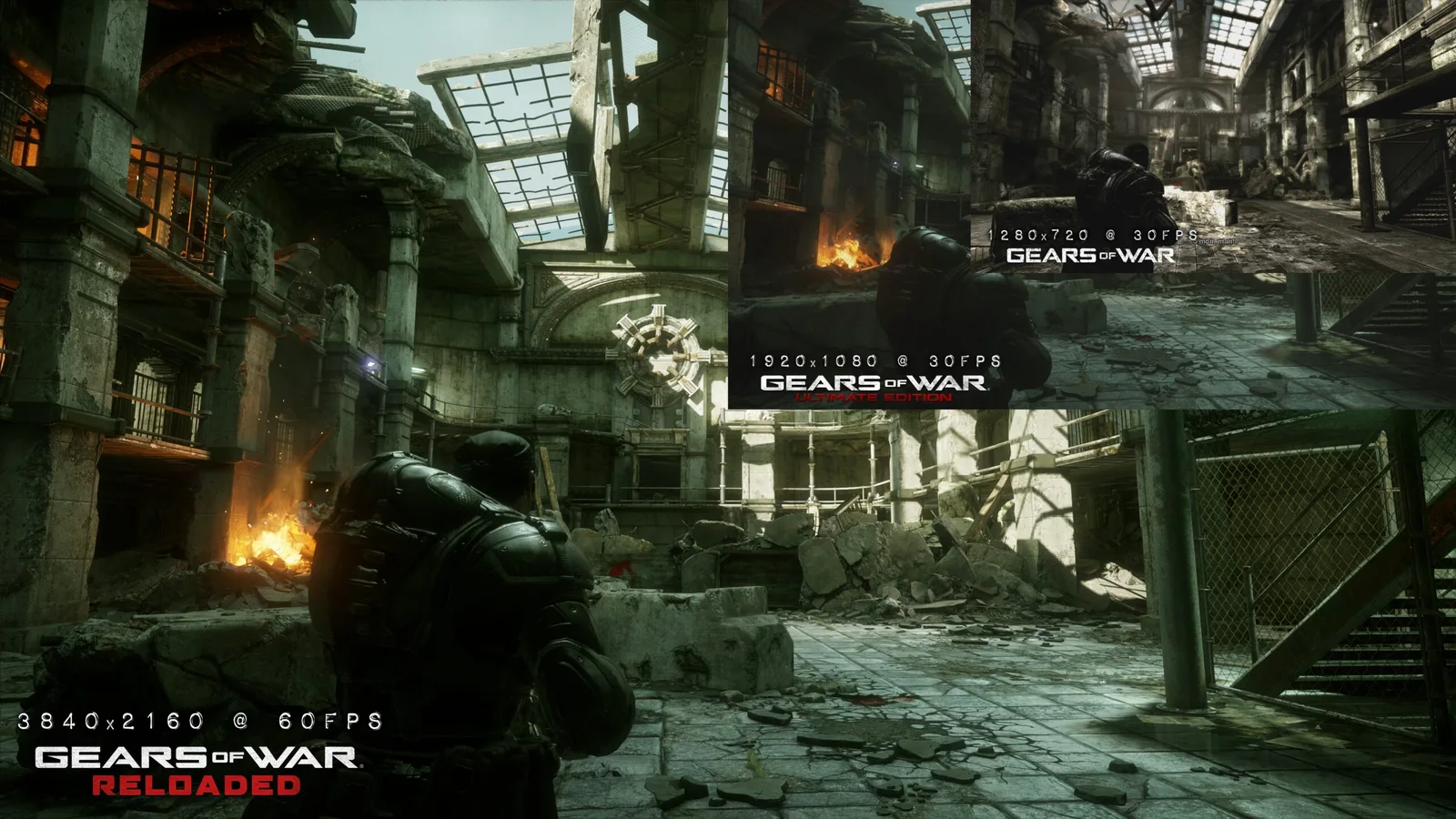
A published comparison of the Gears 1 campaign scene across its original release, Ultimate Edition and Reloaded. The resolution and frame-rate labels belong to this comparison, not an E-Day benchmark.
Reloaded is the appropriate comparison whenever someone means “the original Gears, but remastered.” It retains the original game’s campaign identity while adding remastered textures, lighting, shadows, reflections, modern performance features, refined control choices, and included legacy content.
E-Day has a different purpose. It provides the missing beginning of the Locust War and explores experiences that Gears 1 could only treat as history. Even when E-Day echoes the appearance or tone of the original, those echoes support a new narrative rather than reproduce an old one.
Where E-Day fits in the Gears timeline
The story begins fourteen years before Gears 1
E-Day takes place on the day the Locust Horde first erupts from beneath Sera. The original Gears of War occurs fourteen years later, after humanity has already spent years fighting and losing ground. This time gap fundamentally changes what the characters and player encounter.
In Gears 1, soldiers know the Locust, recognize their weapons, and understand the basic rules of the war. In E-Day, Marcus, Dom, and the people of Kalona are confronting an unknown enemy. Early encounters begin with creatures that look like an uncontrolled monster invasion. The characters gradually discover that the Locust can communicate, manufacture weapons, organize forces, and follow commanders.
The campaign stays with Bravo Squad as Kalona collapses over three days. Marcus and Dom are joined by Mags Carter, a former Gear working at the city’s Imulsion Refinery, and Lucas Reyes, a young cadet and communications officer. The squad experiences the crisis at street level rather than receiving a complete view of the global catastrophe.
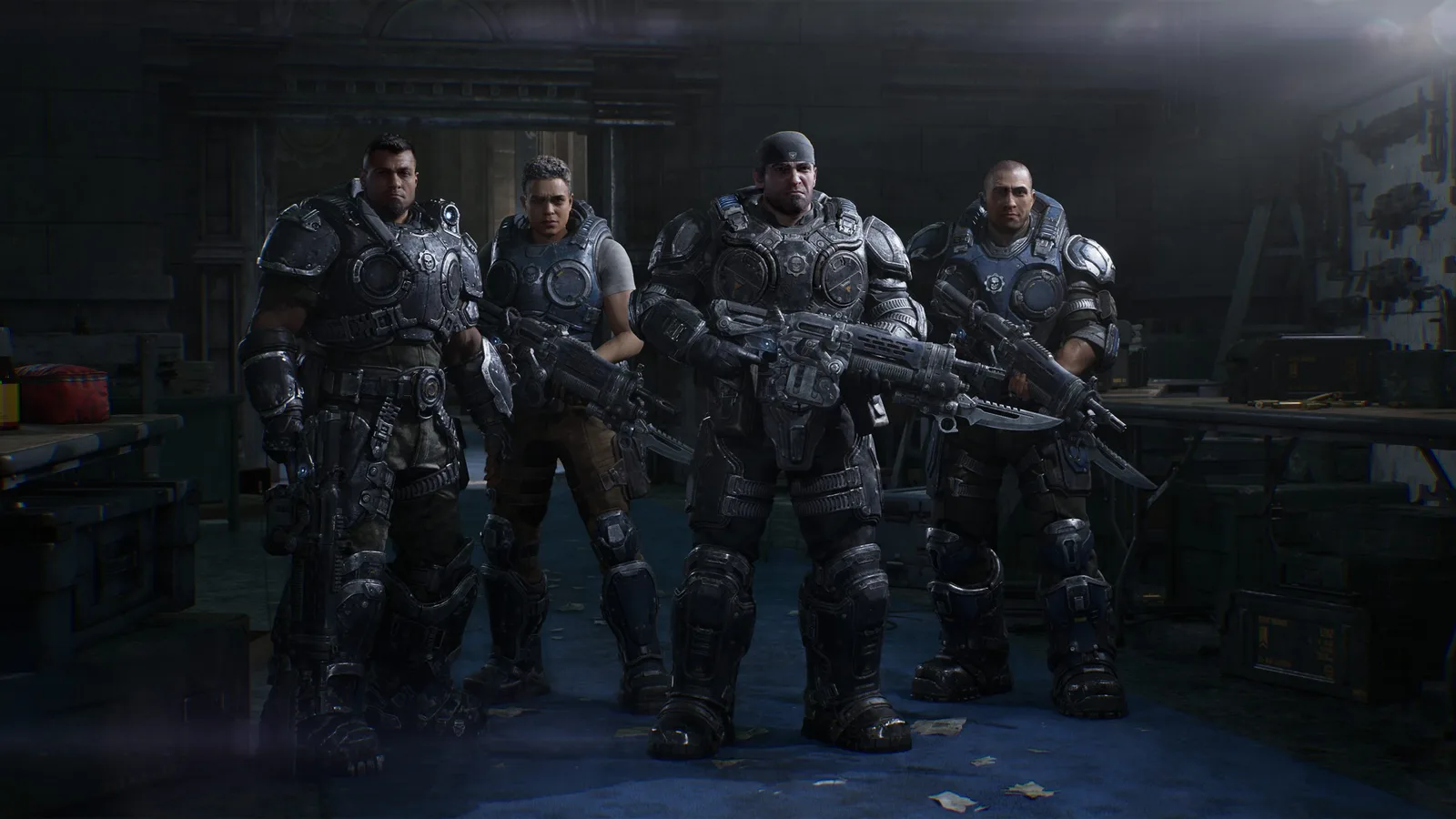
Bravo Squad is the four-person team at the center of E-Day.
That narrow perspective matters. E-Day is not revisiting a war the cast already understands. It shows the confusion, fear, regrouping, and desperation that turn an unexpected attack into the conflict known throughout the rest of the series.
Marcus and Dom have not yet become the pair seen in the trilogy
The prequel setting also allows E-Day to explore Marcus and Dom before their famous partnership is fully formed. Both are veterans of the recently ended Pendulum Wars, but their relationship is strained by shared grief. Carlos Santiago—Dom’s older brother and Marcus’s best friend—died shortly before that war ended.
E-Day uses the invasion to show how Marcus and Dom’s lasting brotherhood begins to take shape. They are recognizable characters, but they do not yet have the experience, confidence, or long history of fighting the Locust that they possess in the original trilogy.
This is another reason “remake” is the wrong description. A remake of Gears 1 would begin with the relationships and circumstances of that game. E-Day starts earlier and uses an unresolved part of the timeline to explain how those relationships developed.
It adds to the established story instead of erasing it
E-Day is also not presented as a reboot. A reboot normally discards or replaces substantial continuity so a series can begin again under different assumptions. The Coalition has described E-Day as a new mainline entry set earlier in the existing timeline, while also stating that it is not retreating from the stories told in Gears 4 and Gears 5.
The game fills historical space rather than declaring that later events never happened. Its campaign can add context to familiar people, weapons, and conflicts because the original games did not describe every detail of Marcus and Dom’s experience on Emergence Day.
That does not mean every mystery in the wider series is rewritten or answered. The useful distinction is simply that E-Day expands the beginning of the timeline; it does not restart the franchise from a blank continuity.
What E-Day rebuilds and reimagines
E-Day is new, but it intentionally reworks familiar Gears ideas. Understanding what has changed helps explain why descriptions such as “reimagined,” “rebuilt,” and “return to the original tone” should not be read as synonyms for “remake.”
A new city and campaign structure
The campaign is set in Kalona, a connected fictional city with a stadium district, industrial waterfront, airfield, residential areas, and refineries. The story follows the city’s destruction during the first three days of the invasion. It is not an open-world game, but its locations were designed to feel like parts of one coherent city rather than isolated stops.
This is newly created campaign material. The player is not following the prison escape, squad journey, or destinations that define the original Gears of War. Kalona instead provides a close view of homes, streets, and public spaces being transformed by the first attack.
Rebuilt Locust encounters
The Locust Drone is familiar, but E-Day presents it from the perspective of people seeing such a creature for the first time. The threat is physically intimidating and poorly understood. Feral Wretches appear before the defenders fully grasp that they are facing a structured army.
The enemies may be called reimagined because their designs, behavior, animation, and role in the horror-focused presentation were rebuilt. That is different from replacing the original Locust encounters inside a recreation of Gears 1.
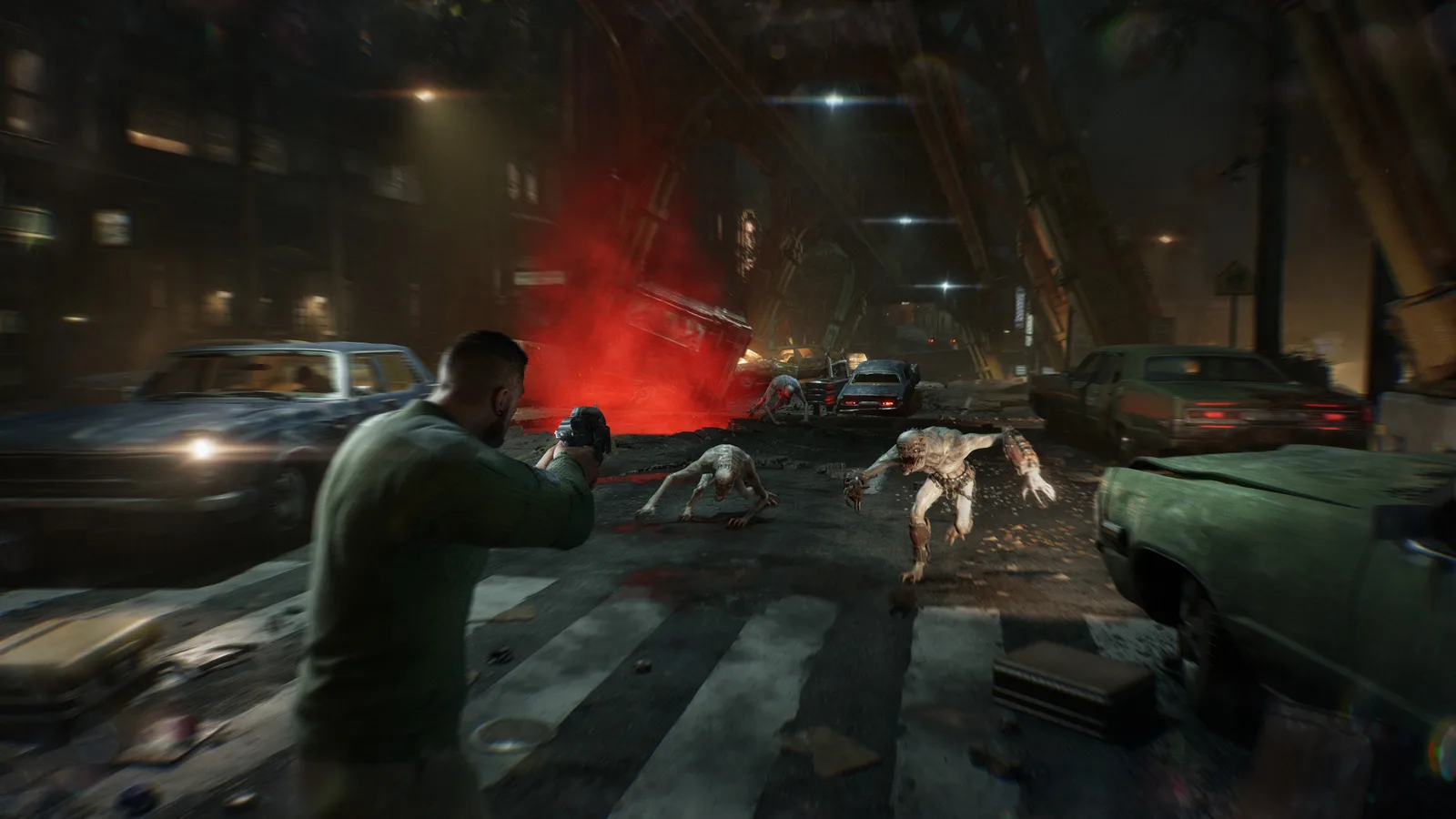
The scene captures E-Day's first-contact horror presentation of the Locust threat.
New movement and combat possibilities
The game retains cover-based combat while adding smoother transitions, more varied cover heights, sprinting slides, jumping, and greater vertical movement. Some districts offer multiple approaches, allowing players to attack directly, move through a side route, or gain elevation.
Weapons also combine established identities with new additions. The Gnasher and Longshot continue to serve recognizable close- and long-range roles. New weapons include the Gut Puncher, which launches armor-piercing explosives with player-controlled detonation, and the Imulsion-powered Incinerator shotgun.
The Chainsaw Lancer receives an origin story within the campaign. Early in this period, Marcus can be seen with the bayonet-equipped MK 1 Lancer rather than the series’ famous chainsaw version. E-Day depicts the Chainsaw Lancer being created on the battlefield from a prototype. That is a new historical event, not a redesigned retelling of the weapon’s use in Gears 1.
How to tell which Gears game you are looking at
Store pages, videos, and search results can place E-Day and Reloaded close together, so use the full title and story description instead of relying only on Marcus, the Locust, or dark visual styling.
- Read the subtitle. “E-Day” identifies the new origin-story prequel. “Reloaded” identifies the remaster of the original game.
- Check the premise. A description about the first Locust emergence, Kalona, or younger Marcus and Dom refers to E-Day. A description calling itself the original game remastered refers to Reloaded.
- Look at the squad. E-Day’s Bravo Squad includes Marcus, Dom, Mags Carter, and Lucas Reyes. The presence of this four-character group points to the new prequel campaign.
- Check the stage of the war. Confused civilians, first contact with the Locust, and a city collapsing over three days belong to E-Day. A setting fourteen years into the Locust War belongs to Gears 1 and therefore Reloaded.
- Do not use graphical quality as the deciding test. Both are modern releases with upgraded presentation. One uses new Unreal Engine 5 content to tell an earlier story; the other remasters an existing classic.
Common labels that do not describe E-Day correctly
- “Gears 1 remake” is incorrect because E-Day does not recreate the original campaign.
- “Reloaded under another name” is incorrect because Reloaded and E-Day are separate products with different stories.
- “Series reboot” is misleading because E-Day is positioned within the established timeline rather than replacing it.
- “Spin-off” is incorrect because The Coalition identifies E-Day as a new mainline entry.
- “Gears 6” is not an accurate story description. E-Day moves backward in the timeline instead of continuing directly after Gears 5.
- “A remaster because everything was rebuilt” confuses production technology with narrative content. E-Day’s assets were created from scratch for a new game.
The distinction to remember
If you want to experience a modern version of the campaign that began the series in 2006, that game is Gears of War: Reloaded. If you want a newly created campaign about the day the Locust War began, that game is Gears of War: E-Day.
E-Day revisits the people, mood, and combat identity that made the original recognizable, but it does so from an earlier point in history. Its younger Marcus and Dom, Bravo Squad, Kalona setting, first-contact story, new weapons, expanded movement, and battlefield origin of the Chainsaw Lancer all belong to a new prequel. The familiar pieces connect it to Gears 1; they do not turn it into a remake of Gears 1.