Use Gnasher hip fire for a close target you can keep aligned while moving, and use ADS when you need a deliberate sighted shot or are fighting toward the edge of the weapon's useful range. A quick pop shot sits between those habits: briefly aim, take the shot, and return attention to movement. None of these choices guarantees a kill without a useful angle and enough of the shot landing.
E-Day ADS fires from the camera position. Hip fire uses a hybrid that checks camera-oriented and muzzle-oriented shots, selecting the result that better matches the intended shot. Launch tuning improved hipfire consistency and increased Gnasher damage while ADS at range. That makes older claims that every hipfire shot is simply muzzle-only or center-only incomplete descriptions of the current system.
Understand what changes when you aim
The key distinction is the way you line up the shot and the game resolves its origin. ADS gives an accurate, predictable view from the camera position. Hip fire uses E-Day's hybrid approach to reduce mismatches between what looks like a hit and what the muzzle alone would produce.
| Choice | Useful situation | What you must still check |
|---|---|---|
| Hip fire | A close opponent during movement | Camera alignment, enemy position, and nearby obstruction |
| Sustained ADS | A deliberate shot across a controlled angle | Enough target exposure and a safe position while aiming |
| Pop shot | A brief aimed shot before resuming movement | That aiming has actually engaged before you judge the result |
Hybrid resolution does not mean every close shot automatically hits. A target can move, the shot can be only partially aligned, and cover can interrupt the angle. Focus on the target's position when you fire rather than only the position where your camera was pointing a moment earlier.
Avoid trying to exploit a target behind your barrel or around a solid obstruction. Launch fixes addressed shooting enemies not in front of the barrel while ADS. A view of the target on screen does not make every angle a valid firing lane.
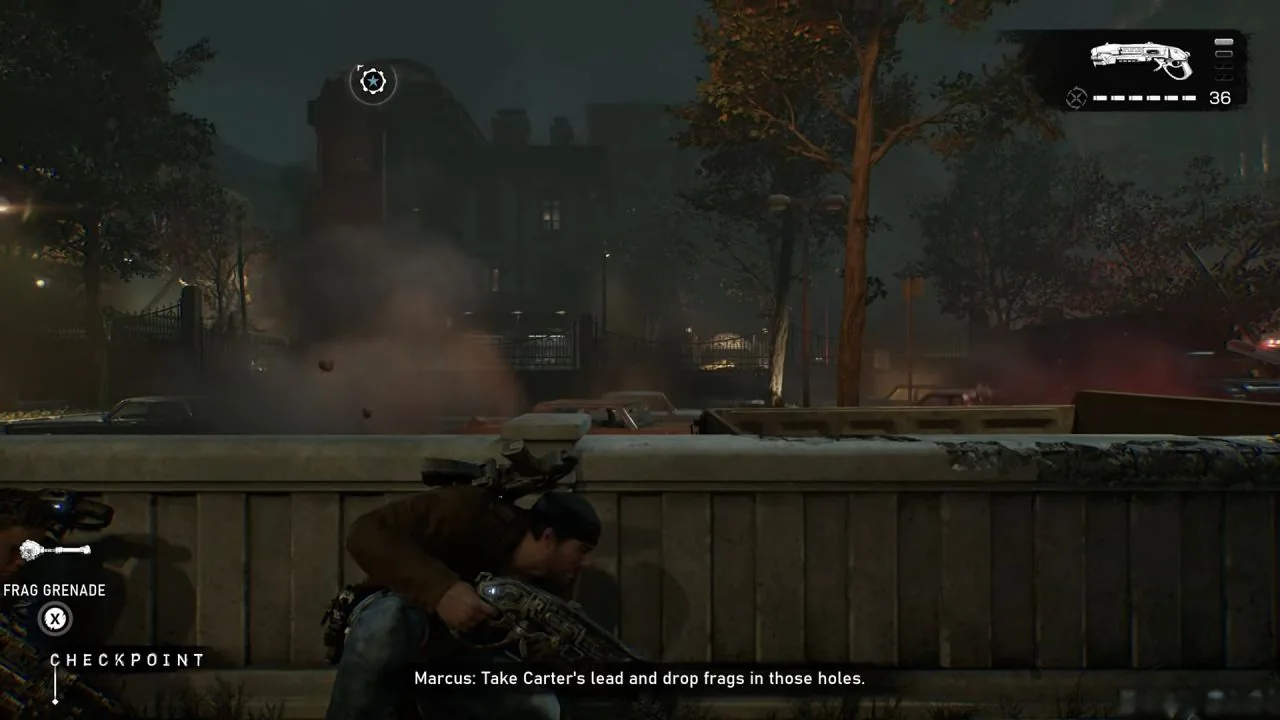
The Gnasher is selected in this unzoomed cover view. The frame shows the normal camera position, rather than an ADS view or a fired shot.
Use hip fire when the close engagement is readable
Hip fire is useful when an enemy is close enough that you can keep the relevant part of their body aligned without holding an aimed view. Watch the center of your camera while moving, but remember that E-Day resolves the shot with its hybrid system rather than the pure origin rules from a different game.
The practical skill is tracking before firing. If you are sweeping the camera past the enemy and pulling the trigger after the target has left the useful alignment, a fast hipfire habit can produce repeated partial hits. Slow the shot enough to see the target at the moment of firing, then add movement as your alignment becomes consistent.
Do not hip fire solely because the opponent is using hip fire. If they are farther away or protected by cover, your situation is different. Choose the shot based on the angle available to you. A missed aggressive shot can leave you exposed to their follow-up while you are still trying to close the distance.
Treat blind firing around a cover edge as its own practice condition. Test the particular edge and position rather than assume every hipfire technique works from every cover shape. Low cover, openings, and narrow gaps can change what is visible and where you can create a useful shot.
Use ADS when precision matters more than continuous movement
ADS is the sensible choice when you have time to line up a target or need a controlled shot at greater distance. Launch tuning increased Gnasher damage while ADS at range. That is a reason to practice aimed shots, not a reason to use the shotgun as a long-range rifle.
Keep the target's exposed body within the aimed view. If cover hides most of the enemy, the shot may not produce the result you expect even when the reticle seems close. Change your angle or wait for a clearer exposure instead of repeating the same low-value shot.
Shoulder swapping while aiming gives another way to approach a covered position. Try the shoulder that produces a cleaner view while keeping you protected. The swap changes your positioning choice; it does not remove the opponent's cover or guarantee that your weapon has a free path.
Aimed movement should remain purposeful. If you hold ADS for an entire duel while enemies approach from another lane, you may lose awareness of the fight outside the aiming view. Take the shot you prepared, check the surroundings, and decide whether the next moment still calls for sustained aiming.
Use pop shots as a timing habit, not a damage exploit
A pop shot means briefly engaging aim to take a shot, then releasing it rather than staying aimed. It can help you combine a controlled camera shot with a moving close fight. It does not create an independently verified damage bonus or bypass every movement restriction.
Begin by practicing the actions separately: aim, fire, release, move. Speed up only once you can see that the weapon is entering the aimed state you intend. If you press several inputs together and are unsure whether the shot was hip fire or ADS, you cannot meaningfully compare the results.
Use a pop shot when a brief sighted view makes target alignment easier without committing to a long aim. For a distant or tightly covered opponent, stay aimed long enough to place the shot deliberately. A quick input sequence is not helpful if it removes the time you need to identify the exposed target.
Do not treat an anecdotal movement clip as proof of a faster firing rate or a universal animation cancel. E-Day has movement commitment and launch adjustments. Learn the current sequence in a repeatable situation before relying on it during a contested objective.
Compare the shots under the same conditions
Combat Training provides a place to practice weapons and short encounters, and Player vs Bot playlists let you apply the habits on multiplayer maps. Use practice to understand the shot you are taking rather than seek a fixed range chart that does not match your conditions.
- Pick one target position and keep your own position stable.
- Use the same weapon state and ammunition state for each comparison.
- Fire a deliberate hipfire shot with the target clearly aligned.
- Repeat with a fully aimed shot from the same angle.
- Add a pop shot after you can perform both basic shots reliably.
- Repeat at another distance, then at a cover edge, without changing every variable together.
An active reload can change the comparison. Do not compare one shot using an active state against another using ordinary ammunition and attribute the entire outcome to aiming mode. In PvE, modifications can also change the weapon's function. Keep those effects separate from the camera-versus-hipfire question.
Record the visible sequence if a result keeps confusing you. Look for the actual enemy position when the trigger was pulled, the cover between you, and whether aiming had engaged. That is more useful than judging from the final damage feedback alone.
Rebuild the choice around cover and movement
E-Day adds sliding, jumping, and climbing, and a slide can include shooting. The shot choice should fit where that movement ends. If a slide leaves the opponent close and clearly aligned, hip fire may be practical. If it ends with a controlled view across a lane, a deliberate ADS shot may be the better follow-up.
Do not slide just to perform a shotgun trick. Choose the destination and check the next cover before starting. A good shot can still be a poor move if it places you in view of several enemies with no safe continuation.
Jumping or climbing can create a new angle over cover. It also changes where your camera and character are positioned. Practice the new view before assuming the alignment from the ground carries unchanged into the raised position.
Launch tuning adjusted cover entry, cover-cancel behavior, slide distance, and strafe responsiveness. Use your current movement to create the angle, rather than copying an older Gears rhythm and deciding the Gnasher is inconsistent when the movement did not end where expected.
Separate PvP aiming from modified PvE shotguns
Versus uses equal starting loadouts and has no Weapon Mods. Campaign and Horde Siege allow customization that can change what a Gnasher shot does. A PvE Slugs configuration, for example, changes the shooting requirement compared with a standard pellet shotgun.
If you want to improve Versus hip fire and ADS, practice with the standard Versus weapon behavior. Do not use a modified PvE setup to claim a universal one-shot distance or to explain every PvP result. The aiming technique and the weapon configuration are related but separate choices.
In Horde, class progression, difficulty, and the enemy you hit also affect the result. A body shot against one enemy type is not equivalent to the same-looking shot against another. Compare shots against the same target under the same conditions before changing your entire aiming habit.
The right way to use a modified shotgun is to understand its new requirement. If a mod rewards a more precise projectile, deliberate aim may become more valuable. If you return to the standard weapon, reassess the shot rather than keep expecting the modified behavior.
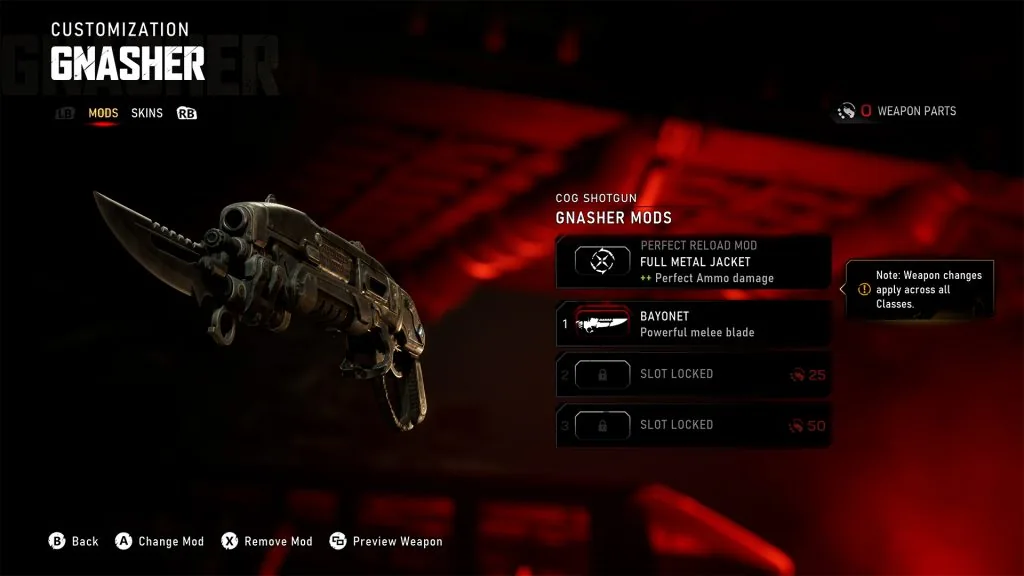
July preview illustration of PvE Gnasher modifications. These menu entries illustrate why modified shotguns should be kept separate from a standard Versus aiming comparison; preview costs are not current values.
Diagnose the miss before choosing a different technique
| What you observe | What to check first | Useful next practice |
|---|---|---|
| Close hipfire feels weak | Target alignment at the firing moment | Track a stationary then moving target without extra movement |
| ADS hits cover | Exposed body and firing angle | Compare shoulders and reposition at the same cover edge |
| Pop shot gives an unexpected result | Whether aim engaged and ammunition state matched | Separate aim and fire, then shorten the sequence |
| Sliding shots vary | Where the movement ends and where the camera points | Repeat one slide route before adding an opponent |
| PvE feels different from Versus | Mods, class, difficulty, and enemy | Return to equivalent standard-weapon conditions |
A weak result is not automatically proof that hip fire is worse or that ADS is mandatory. It may reflect a partial shot, a different range, a changed ammunition state, or an obstructed angle. Correct the condition you can observe before adopting a blanket rule.
If repeated outcomes remain abnormal under controlled conditions, keep the clip and the conditions. This comparison alone cannot prove a networking problem or a game-wide damage bug. Avoid presenting an online duel's confusing result as a measured weapon breakpoint.
Apply the choice in a normal fight
Against a close opponent moving through an open angle, track with the camera and use hip fire when alignment is clear. Against an opponent exposing a smaller target beyond the closest engagement, take the extra time to aim. During a moving duel, use a brief aimed shot if it helps place the hit, then return attention to positioning.
Keep a fallback for a fight beyond the Gnasher's useful role. Change to a rifle, support a teammate's angle, or move through cover instead of spending every shell on a distant target. The question is not which technique wins every duel; it is which shot your current position can deliver reliably before the next threat changes the fight.