For a first campaign run, plan around fourteen hours for the main story and roughly sixteen hours if you include side content. The October 7, 2026 HLTB snapshot lists a Main Story average of 13 hours 56 minutes from three submissions and a Main + Sides average of 16 hours 10 minutes from six submissions. These are early player averages, not a promise that your playthrough will finish at that exact time.
There is no supported Completionist estimate in this snapshot. The field is blank, and the detailed single-player table does not contain a Completionist row. Do not turn the fifteen-hour overall figure into a hundred-percent estimate, and do not borrow a completion time from a different Gears game. Finishing E-Day's story, searching its campaign, and finishing long-term multiplayer achievements are different time commitments.
Read the categories before choosing an estimate
HLTB groups submissions by the player's approach. Main Story is the most relevant category if you want to follow the campaign's core objectives and reach its ending. Main + Sides is more relevant if you expect to do optional activities along the way. Completionist would be the category to inspect for a more exhaustive run, but E-Day does not yet have a supported figure there in the current snapshot.
| E-Day category | Submitted playthroughs | Average | Median |
|---|---|---|---|
| Main Story | 3 | 13h 56m | 14h |
| Main + Sides | 6 | 16h 10m | 16h 7m |
| All PlayStyles | 9 | 15h 25m | 14h 18m |
| Completionist | No populated row | Not available | Not available |
The All PlayStyles row combines the available approaches. It can summarize the small collection of submissions, but it does not describe a separate route you can follow. If your goal is the story, use Main Story. If you plan to take detours, use Main + Sides. An overall average is less useful once you already know which of those approaches resembles your intended run.
The headline values are rounded and easy to misread when separated from their labels. The detailed table provides the clearest association between category and time. It also shows why the numbers should remain approximate: three main-story submissions cannot capture every difficulty, skill level, cooperative setup, or amount of retrying.
Main-story time means a focused campaign
E-Day's campaign follows Marcus and Dom through the opening Locust invasion, with Mags Carter and Lucas Reyes forming the rest of Bravo Squad. A focused run follows the main objective rather than treating every explorable space as a complete search task. You can still stop to understand a new weapon or inspect an interesting area without turning the run into an exhaustive campaign sweep.
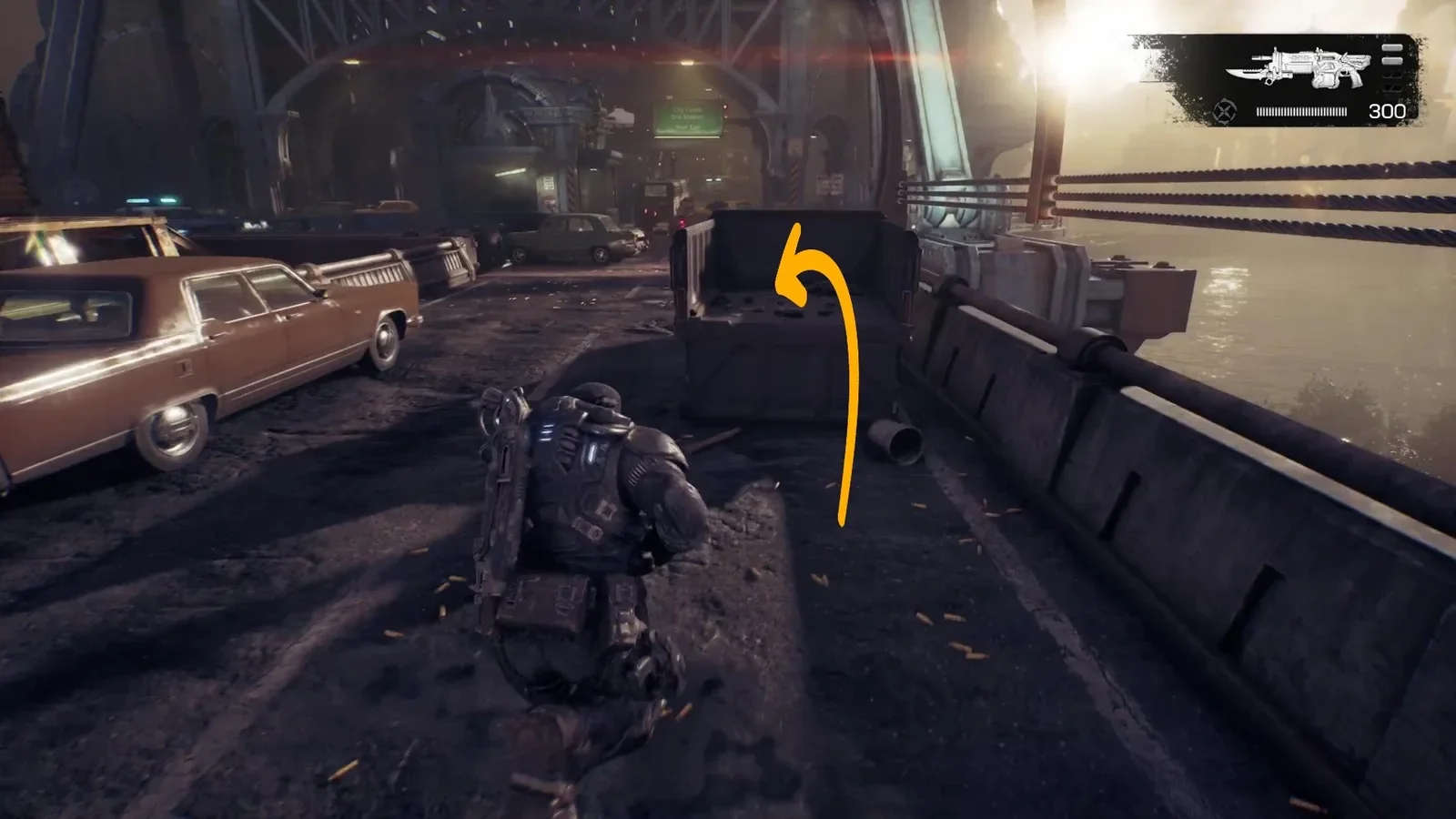
A street-route example illustrates following the campaign path; it does not establish a completion time.
The fourteen-hour planning figure is useful because it tells you the scale of the commitment. It suggests several substantial sessions rather than a brief evening diversion. It does not specify the length of every act or chapter, and it should not be divided into equal chapter blocks. Encounters, dialogue, exploration, and retries do not occupy identical amounts of time throughout a campaign.
If you are choosing between finishing this game first or beginning another long game, keep the estimate tied to the ending. A main-story completion is a clear milestone even if you later return for optional tasks or multiplayer. That lets you plan the first run without pretending that every future hour in E-Day belongs to its campaign length.
Difficulty can change the experience even when the route stays the same. More failed encounters mean more repeated play, while an easier setting can preserve momentum for someone interested mainly in the story. There is no separate difficulty-specific HLTB breakdown here, so do not assume the listed average measures your preferred difficulty precisely.
Side content changes both time and pacing
Main + Sides averages 16 hours 10 minutes in the early table, with a median of 16 hours 7 minutes. That is roughly a couple of hours beyond the main-story average, but it should not be interpreted as a guarantee that every optional activity takes only that difference. These are separate groups of player submissions, not the same players completing two controlled routes.
Campaign detours include secondary objectives, searches for Hard Cases, and collectible exploration. Hard Cases connect exploration to weapon modifications, which can make a search appealing even if you are not interested in a complete collectible record. The time you spend comparing equipment and choosing modifications is also part of how you personally experience the run.
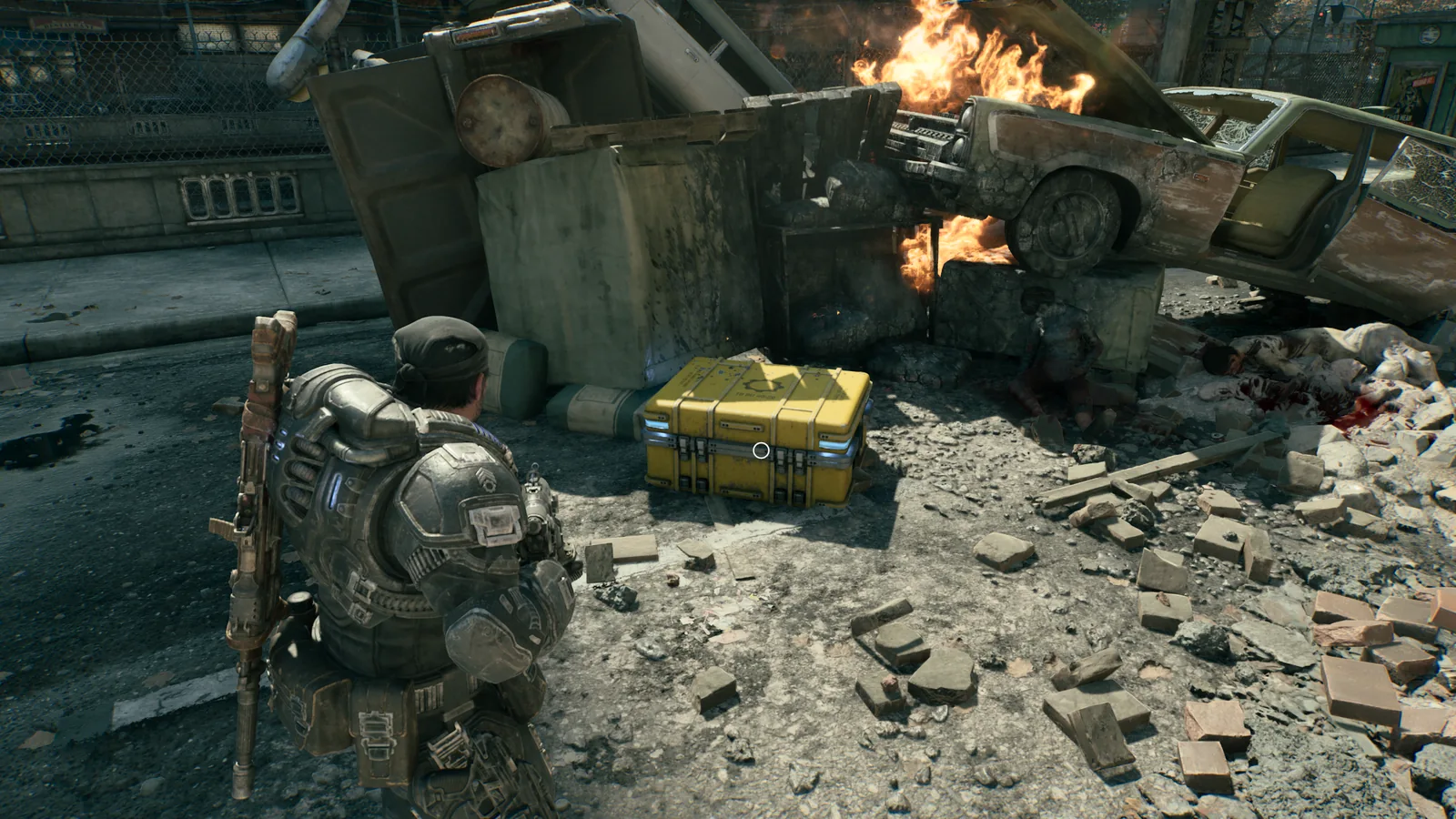
Checking a yellow Hard Case is an optional detour that adds time to a focused story run.
Choose your approach before starting a group session. If one player wants to see every side street while another wants the next story scene, a nominal sixteen-hour estimate does not solve the disagreement. Agree on whether optional objectives are routine, whether searches stop after a quick pass, and whether you will return for missed items later.
A useful first-run rule is to take the detours that interest you without requiring perfect completion immediately. This preserves the campaign's momentum while giving you room to experience its exploration and equipment systems. If complete collection is your actual goal, keep a separate record rather than assuming the Main + Sides label means that every optional item has been found.
There is no reliable hundred-percent time yet
The blank Completionist figure means that the snapshot cannot support a numerical estimate for a full-completion run. It does not mean full completion takes no extra time, and it does not mean it is impossible. It means the populated timing categories do not answer that question yet.
Define what you mean by completion before trying to budget it. You might mean finishing every campaign chapter, collecting all campaign items, meeting a difficulty goal, or earning every achievement across the whole game. Those goals can overlap, but they are not interchangeable. A campaign ending is much narrower than an achievement plan that also includes multiplayer progress.
E-Day has player-level, class, medal, and challenge systems in addition to the campaign. A time submitted under a single-player category should not be treated as a forecast for those systems. Likewise, a person's total launcher playtime may include menus, multiplayer, retries, or time away from the controller. It is not automatically a clean measure of the story route.
For a hundred-percent plan, use the campaign estimate as the first stage and leave the additional stage unnumbered until you have a defined checklist and better timing data. That is more useful than assigning an attractive but unsupported number. You can still schedule the first playthrough now without knowing exactly how long every later goal will take.
Turn the estimate into realistic sessions
The following examples are simple scheduling arithmetic using the approximate fourteen-hour and sixteen-hour campaign figures. They are planning examples, not additional measured completion times. Allow room for setup, group coordination, and stopping at a convenient point rather than expecting each session to contain uninterrupted progress.
| Available campaign time per session | About 14 hours of story | About 16 hours with side content |
|---|---|---|
| 1 hour | Around 14 sessions | Around 16 sessions |
| 90 minutes | Around 10 sessions | Around 11 sessions |
| 2 hours | Around 7 sessions | Around 8 sessions |
| 3 hours | Around 5 sessions | Around 6 sessions |
A two-hour evening does not always produce two hours of useful progression. Friends may need time to connect, a player may change equipment, or an encounter may take several attempts. Plan a stopping window rather than a deadline to finish a specific chapter whose length is not established.
If you want a weekend campaign, add your available hours before relying on the average. Two short evenings are not equivalent to a fourteen-hour block, and a single long day can be less comfortable than several sessions. The estimate is most useful when it helps you choose a pace you can sustain, not when it pressures you to keep playing after you are tired.
For a regular cooperative group, reserve the same type of session each time. A predictable two-hour slot is easier to coordinate than assuming everyone can stay until the next major story milestone. Keep a little flexibility near the expected end of the campaign because a player average cannot predict your final session exactly.
Cooperative play is not a guaranteed shortcut
The campaign supports up to four players online, and Xbox supports two-player local split screen. PC does not support local split screen. Those options can change how you arrange sessions, but the current timing data does not establish a distinct E-Day co-op completion estimate.
Human teammates can help coordinate revives and cover different threats. They can also spend more time discussing routes, searching side areas, or waiting for everyone to be ready. Neither effect supplies a fixed discount to the fourteen-hour figure. Start with the category that matches your group's route and adjust the schedule based on how your first sessions actually go.
Progress should be checked individually when players join an existing campaign. The October 5 update fixed specific join-in-progress War Journal and Forge issues, including unintended awards of earlier progress. Do not assume that joining near the ending establishes a complete campaign run for everyone. If your group wants to finish together, start from the same intended point and inspect each player's records afterward.
That matters when tracking time too. Record the sessions in which you participated rather than copying the host's total. A shared campaign can include different amounts of participation, and a personal completion record should reflect your own route through the game.
Platform numbers do not prove a faster version
The early platform table includes five PC submissions and four Xbox Series X/S submissions. Its main-story cells are 13 hours 45 minutes for PC and 14 hours 18 minutes for Xbox Series X/S. Its Main + cells are 13 hours 33 minutes and 18 hours 47 minutes respectively. These small, uneven categories are not a performance benchmark.
Different players can choose different routes or difficulty settings, and the table does not control for those choices. The shorter PC Main + value is not a reason to conclude that optional content takes less time than the main story. It reflects the available submissions in that category, not a rule about how the game is structured.
Choose a platform based on the version you can comfortably play and the people you want to join. A few minutes of apparent timing difference should not override a workable cooperative setup. For time planning, the category-level fourteen- and sixteen-hour figures are more useful than treating sparse platform cells as a race between versions.
Track your own pace after the first sessions
Record your starting point, ending point, and approximate active session time. Also note whether the session focused on the main objective or included substantial searches. This gives you a more relevant picture than comparing every evening against the average without accounting for what you actually did.
If your first session takes longer than expected, decide whether the cause is your preferred pace, repeated combat attempts, or a technical interruption. Exploration is part of a chosen route; a stalled loading screen is not a meaningful measure of campaign length. Keep those observations separate so that you can change the schedule or address the problem appropriately.
For a focused story run, start with roughly fourteen hours and retain an extra session if you need it. For a run with regular optional content, start with roughly sixteen hours and allow further room for thorough searching. Leave a full-completion estimate open. That gives you a workable plan while respecting the limits of the early HLTB sample.