Editorial assessment: This article compares published campaign and multiplayer information with reported launch impressions. No site-owned playtest or scoring session was recorded for this assessment.
Gears of War: E-Day is a strong fit if you want a story-driven cover shooter built around Marcus Fenix, Dom Santiago, and a squad facing the first hours of the Locust invasion. Its clearest strengths are the campaign's character focus, expanded weapon choices, and combat that adds mobility without abandoning the importance of cover. The biggest buying considerations are launch stability, changes to familiar movement, and whether Horde Siege matches the kind of cooperative experience you want.
This assessment separates the campaign from the multiplayer package. A compelling story campaign does not establish that online matchmaking, long sessions, or competitive balance will work equally well for every player. As of October 7, 2026, Ranked Versus is scheduled for October 13, so an assessment of the complete ranked experience would be premature. If that is your main reason to buy, the launch campaign verdict answers only part of your decision.
The campaign's strongest reason to play
E-Day takes place fourteen years before the original Gears of War. That changes the emotional stakes: Marcus and Dom are younger, the Locust are an unfamiliar threat, and the people of Kalona have to understand an invasion while surviving it. Returning players know the broad direction of the series, but the characters do not share that knowledge. The campaign uses that gap to make familiar enemies feel threatening again.
The story's value is not simply the chance to recognize a monster or weapon from an older game. It is the contrast between two experienced soldiers and a crisis that military experience cannot immediately explain. Their relationship gives the action a human anchor. The setting also gives new players a clear entry point: you can follow the immediate disaster without treating a detailed history of later games as required homework.
Mags Carter and Lucas Reyes join Marcus and Dom in Bravo Squad. Their presence matters because a four-person campaign needs more than two recognizable leads and two empty cooperative slots. The campaign gives the new squadmates room within the story rather than relying entirely on the audience's attachment to Marcus and Dom. If your interest is the squad's reactions, exchanges, and changing sense of the disaster, this is the part of the game most likely to meet it.
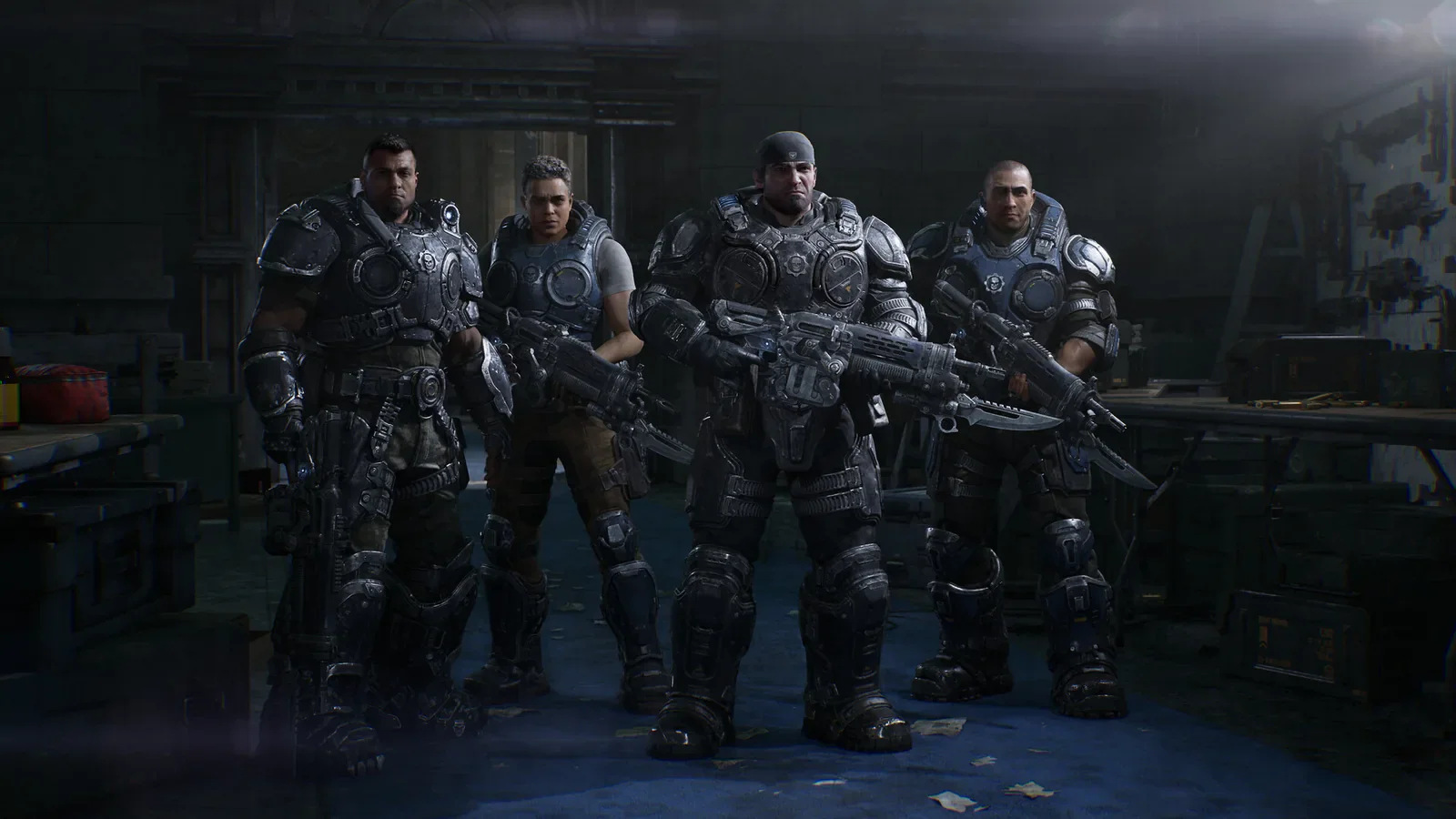
Bravo Squad gives the campaign four distinct characters around whom online co-op is built.
There is still a limit to what a prequel can promise. This is a beginning for the Locust conflict, not a continuation of the unresolved direction of Gears 5. Choose it because you want this earlier setting and its characters. If your main interest is the next chronological step after that game, returning to Emergence Day will not answer the same narrative question.
More room to explore without losing the firefights
The campaign combines concentrated battles with areas that allow exploration, secondary objectives, and searches for Hard Cases. That structure gives you reasons to leave the direct route beyond simply filling a collectible counter. Weapon modifications can affect the tools available for the next encounter, so a detour has a combat purpose as well as a completion purpose.
The practical tradeoff is pacing. A city under attack creates urgency, while an optional side route asks you to slow down and search. Players who enjoy inspecting the environment and improving their equipment may see this as worthwhile breathing room. Players who want one battle to lead immediately into the next may prefer to follow the central objective and leave optional tasks for later.
Neither approach is inherently wrong. For a first playthrough, decide whether your priority is the story's momentum or a broader pass through the available activities. You do not need to treat every quiet stretch as a mandatory search session to understand why the campaign works. Equally, rushing past the optional content can hide some of the flexibility that separates E-Day from a straightforward sequence of corridors.
The opening invasion also helps the environments carry meaning. Fighting through streets and damaged buildings is different from crossing an arena whose only purpose is to host enemies. Cover still defines the immediate battle, but the larger spaces let your route between fights contribute to the sense of a city collapsing around the squad.
Combat keeps the weight and adds choices
E-Day retains the defining relationship between positioning, cover, and firepower. Running into open ground remains a commitment. What changes is the number of ways you can execute a plan: sprinting, sliding, jumping, climbing, and shoulder swapping give you more options for approaching an angle or escaping one.
That makes the game easier to understand if you stop expecting every input to reproduce a previous entry exactly. New traversal is useful because it changes access to a firing position. It does not remove the need to judge whether an enemy can hit you during the move. A slide can create a quick attack angle, but choosing the moment remains more important than performing it repeatedly.
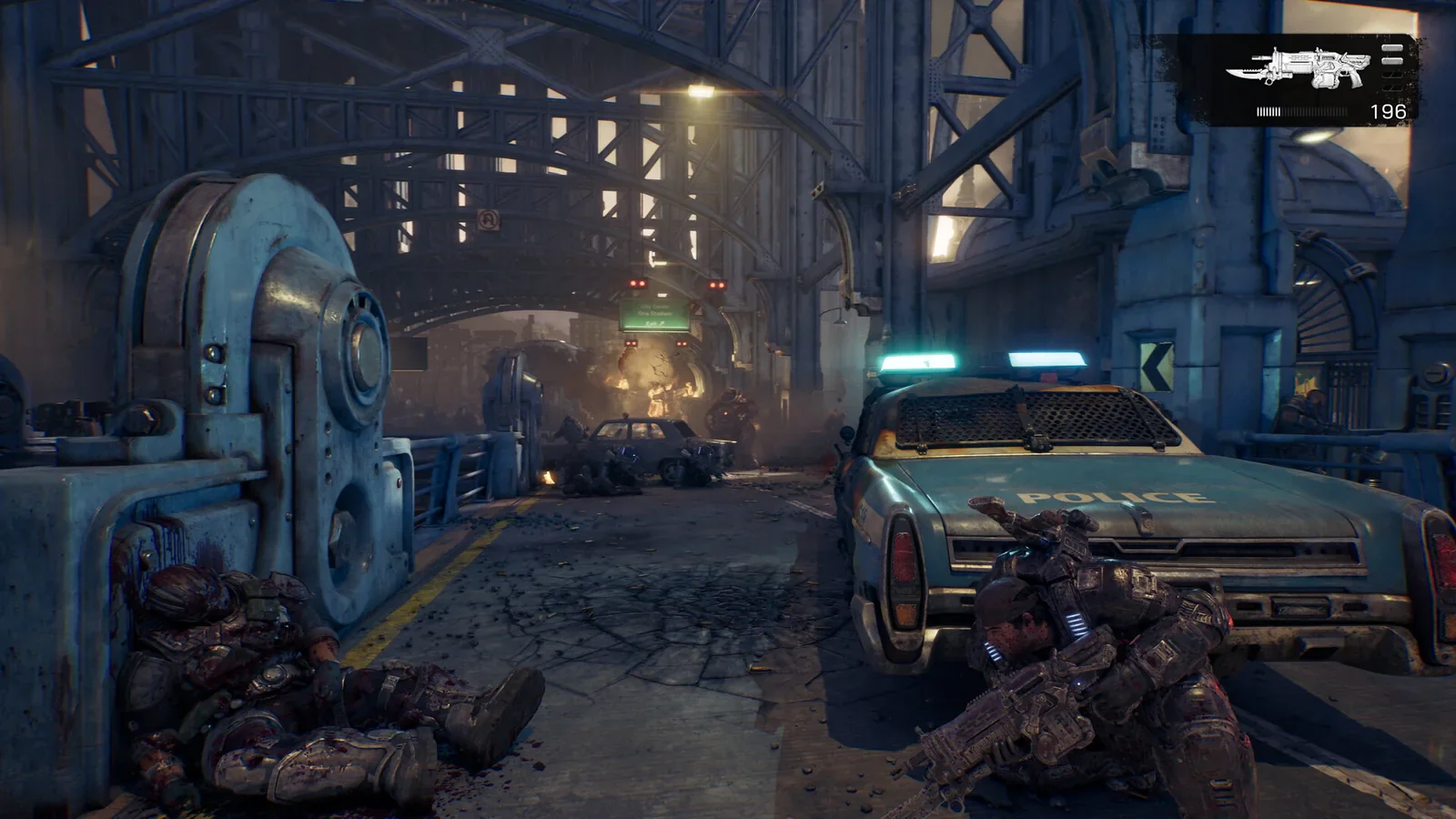
The street fight combines a protected position with an exposed route toward the enemy.
The movement changes will divide returning players for a reason. A player who values the older games' exact rhythm may notice altered commitment and momentum immediately. A player who wanted additional ways to navigate wider spaces may welcome the same change. Legacy-style controls can address an input preference, but they cannot turn the entire combat sandbox into an older game.
Gunplay also asks for attention beyond the reticle. Projectiles have travel time, shoulder swapping changes how you use an angle, and weapon recoil gives short bursts a purpose. These additions support more deliberate choices about range and exposure. They are strongest when the fight gives you time to recognize a threat and select an appropriate response, rather than when you try to force the same close-range weapon into every encounter.
Weapons and modifications reward adaptation
The weapon roster mixes familiar equipment with new options. The Gnasher, Prototype Lancer, Hammerburst, Breechshot, and other tools serve different distances and combat situations. Their value is not that one obvious choice replaces every other gun. It is that a change in the enemy group or battle layout can make a different weapon useful.
Campaign weapon modifications reinforce that idea. Finding a Hard Case or completing an optional objective can expand the adjustments available to your equipment. Rather than treating every upgrade as a reason to use the same gun forever, think of the system as another way to prepare for a particular fight. Accuracy, capacity, and other supported modifications have a purpose when they solve a problem you actually encounter.
The Gnasher's round-by-round reload is a useful example of the broader design direction. You can make a tactical choice about replenishing enough ammunition to continue a fight instead of treating the full reload cycle as the only option. This gives combat more decisions without requiring an entirely different genre or abandoning the series' recognizable weapons.
Enemies contribute to that flexibility. Boomers, Drones, Wretches, Seeders, and Reavers put different pressures on a squad. Some threaten your cover, some create an approach problem, and some change the space you can safely use. The campaign benefits when those threats encourage a change in positioning and loadout instead of merely increasing the amount of ammunition you must spend.
Cooperative play changes the campaign's appeal
You can play alone or with up to four players online. Xbox supports two-player local split screen, while PC does not support local split screen. That distinction is important when buying specifically for a shared evening: two people with one PC cannot assume that online cooperative support includes a couch mode.
With friends, the campaign's squad structure becomes a shared experience rather than a story delivered around AI teammates. You can divide attention between enemies, communicate about a detour, and agree on when to continue. Those advantages are particularly relevant if you prefer coordinating revives and equipment rather than relying on companion behavior.
The solo experience deserves its own consideration. Campaign impressions have included inconsistent AI revives, which can make a difficult encounter frustrating when a companion is nearby but does not help. That is a concern rather than a claim that every encounter is broken. If you plan to play alone, choose difficulty around the experience you want and leave room to adjust after seeing how the squad behaves in your own session.
Online progress is another practical issue. The October 5 patch addressed specific join-in-progress War Journal and Forge problems, including unintended awards of progress earned before someone joined. Joining a friend's advanced save should not be treated as a shortcut that grants everything the host already completed. Confirm your own records if full campaign completion matters to you.
Horde Siege is a different cooperative proposition
Horde Siege puts twelve players into a shared battlefield as three four-person squads. Each squad pursues its own mission, can cross paths with the others, and may join larger invasion events. That creates cooperation at two scales: the immediate decisions of your own squad and the wider response to threats affecting the map.
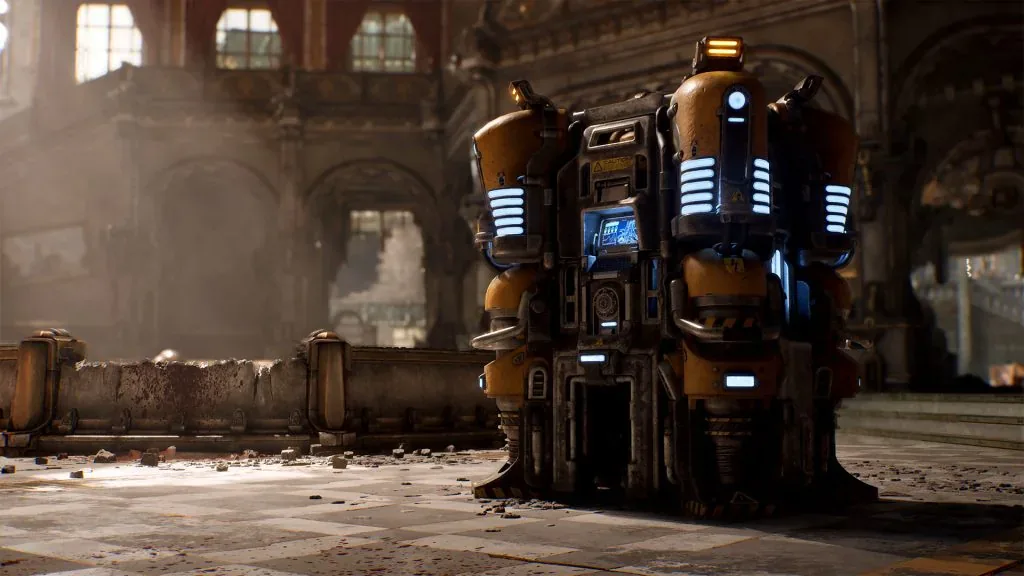
The R.I.G. is a mission device in Horde Siege; this preview identifies the object rather than showing a completed defense.
This is an appealing direction if you like moving objectives, class progression, and a reason to adapt equipment between missions. Assault, Breacher, Marksman, and Medic offer different roles, while modifications create longer-term loadout choices. The mode gives you a repeatable reason to return after the story without simply asking you to replay the campaign.
It also changes the expectation attached to the word Horde. If your ideal session is a familiar fifty-wave defense in one established position, do not assume Siege supplies that exact format. Its playlists include shorter moving missions and a ten-wave defense option. Enjoying the campaign does not guarantee you will prefer this structure over an older version of Horde.
Extraction adds a meaningful final condition. Collecting Weapon Parts during a mission is not the same as banking them: your squad needs a successful extraction, with at least one member getting out, to retain the parts. This makes the final stage of a run matter, but it also raises the cost of instability or a failed evacuation. For players with limited uninterrupted time, that risk belongs in the purchase decision.
Launch issues affect the value of the package
The October 5 update included stability and performance work, matchmaking fixes, and several campaign and Horde objective repairs. That improves the launch baseline, but a patch list is not a guarantee that every hardware configuration or lengthy session is trouble-free.
Older reports need particular care. A problem discussed during the August beta may already have changed, and a campaign review recorded before the live multiplayer launch cannot measure the final servers. Conversely, a recent fix for one cause of an objective stall does not establish that every similar symptom has disappeared.
For PC players, hardware suitability and actual stability should weigh alongside the game design. For console players, performance preferences and the intended cooperative setup matter. The useful question is whether the version you can play delivers the experience you are buying it for, not whether a single score describes every mode equally well.
For a group purchase, compare the Xbox and PC co-op setup first. If your priority is the story, the campaign length guide explains the limits of the early playtime estimates.
Choosing based on the part you want to play
| Your main reason to play | Best reason to consider E-Day | Decision to make first |
|---|---|---|
| Marcus and Dom's earlier story | A character-focused first-contact campaign | Accept that this is a prequel rather than a Gears 5 continuation |
| Cooperative story sessions | Four-player online campaign support | Check how many devices you need and who will host |
| Repeatable PvE | Classes, modifications, shared battlefields, and extraction | Decide whether Siege's mission structure suits you |
| Competitive multiplayer | A rebuilt 4v4 combat sandbox | Allow time to learn movement and wait for Ranked to open |
| Solo campaign completion | Exploration and loadout options between battles | Account for companion behavior and optional-content pacing |
The strongest case for E-Day is the combination of a focused campaign and combat that gives a familiar squad new problems to solve. If those are your priorities, the game offers a clear reason to play. If you are buying mainly for Ranked, exact legacy movement, or a specific old Horde format, those requirements deserve their own check before you treat the campaign's strengths as a verdict on the entire package.