Gears of War: E-Day still lets you cancel a cover entry, but classic rapid wall bouncing no longer works at the same pace. You must commit farther into the approach before cancelling, and momentum prevents an immediate full-speed reversal. Cover entry remains fast, but repeated cancels are slower, more predictable and easier for another player to read.
The practical adjustment is to use fewer cancels, choose the destination before starting the movement and allow your character's momentum to transfer before changing direction. Sprint, evade and slide now cover situations where older games encouraged another bounce. Wall cancelling has not disappeared; it has become one deliberate part of a larger movement system.
The launch version changes the old wall-bounce rhythm
E-Day's cover system was rebuilt rather than copied from Gears 5 or the original trilogy. The earlier games allowed a player to begin a cover entry and escape that trajectory relatively early. Skilled players could link those early cancels between nearby surfaces, creating the rapid direction changes commonly called wall bouncing or hyper-bouncing.
E-Day moves the usable cancel later in the approach. The character travels closer to the selected cover object before the escape becomes available. That extra commitment exposes more of the intended path and gives an opponent more time to understand where the player is moving.
Momentum adds a second limitation. A cancel can slow the character sharply, but a complete reversal takes a short time. Moving toward a wall, cancelling and immediately trying to launch in the opposite direction therefore produces a more physical transition instead of the instantaneous snap familiar from some legacy movement.
An important version detail explains why different descriptions may quote different numbers. The pre-launch gameplay breakdown described cover-entry cancellation as becoming available within 1.5 meters of the cover object. The official launch notes later said that both cover-entry speed and the distance of the cover-enter cancel had been adjusted after the multiplayer beta, but they did not publish a replacement distance. Treat 1.5 meters as the earlier documented implementation, not a guaranteed current measurement to reproduce with a ruler. The launch behavior that remains clear is later commitment, slower chaining and preserved momentum.
| Movement property | Legacy habit | E-Day behavior | Required adjustment |
|---|---|---|---|
| Cancel opportunity | Escape early during the cover approach | Commit closer to the cover before cancelling | Start only when the approach itself is safe |
| Direction change | Reverse almost immediately | Momentum takes time to transfer | Finish the slowdown before redirecting |
| Chained cancels | Link surfaces at maximum rhythm | Cancels must be paced more slowly | Use fewer links with clearer destinations |
| Movement speed | Depend on cover entries to remain fast | Cover is fast, but sprint, evade and slide are competitive alternatives | Match the movement tool to the route |
| Readability | Rapid changes can conceal the next action | Trajectories and animations are easier to follow | Expect opponents to anticipate repeated patterns |
How an E-Day cover cancel works
A cover cancel begins with a normal cover-entry action. Your Gear accelerates toward a valid surface, but you interrupt the entry before attaching to it. The familiar idea survives; the timing and physical response are what changed.
The sequence now has three distinct phases:
- Commit to the surface. Aim the movement toward valid cover and begin the entry. Do not assume that the cancel will register as soon as the animation starts.
- Reach the later cancel window. Let the approach carry you close enough to the object. An input made too early may leave you continuing toward cover because E-Day requires more commitment than previous games.
- Transfer momentum before redirecting. The cancel can remove speed quickly, but the character cannot instantly apply that speed in the opposite direction. Give the turn time to complete instead of stacking frantic inputs.
This design does not make cover entry slow. The official movement breakdown describes entering cover as one of the fastest actions available. What changed is its position relative to the rest of the movement sandbox: it is no longer such an extreme speed advantage that bouncing between walls becomes the automatic answer to every short route.
A practice routine for rebuilding your timing
Use E-Day's practice space or a quiet combat area with two easy-to-read cover objects. Choose surfaces with a clear approach and enough open floor to see the entire animation. Avoid learning beside irregular debris, low gaps or climbable ledges because those objects can introduce other contextual actions.
Establish the new cancel point
- Stand several steps from one uncomplicated cover object.
- Begin a cover entry without trying to cancel it. Watch how the character accelerates and where the final attachment begins.
- Repeat the entry and attempt one cancel late in the approach.
- On each repetition, move the input slightly earlier until you find the point where an early attempt no longer interrupts the entry reliably.
- Return to the dependable later timing rather than trying to balance on the earliest possible frame.
The goal is not to memorize a universal distance. Camera angle, approach geometry and the post-beta tuning make a visual timing cue more useful than the old 1.5-meter description. Learn what the character looks like when sufficiently committed to that particular wall.
Add the momentum transfer
After a single cancel feels reliable, move away from the wall without forcing an immediate opposite-direction launch. First observe the sharp slowdown. Then apply the new direction and note the short transition required for the body to follow it.
Repeat in both directions. If the movement feels delayed, check whether you are asking for the reversal before the previous action has finished transferring momentum. Adding more inputs will not remove the physical transition; it can instead make your intended route harder to control.
Link two surfaces slowly
Place the character between two valid pieces of cover and link one cancel on each side. Begin at a deliberately slow cadence. Each movement should have a readable approach, a late cancel and a completed redirect.
Only increase the rhythm while all three parts remain distinct. If the character attaches to cover unintentionally, the cancel was probably attempted outside the usable window. If the turn feels heavy or carries you along the first trajectory, the reversal was probably requested before momentum had transferred.
Replace one link with another movement tool
Once two-surface movement is consistent, remove one cancel from the pattern. Use sprint, evade or a sprint-triggered slide for that portion of the route. This teaches the central E-Day adjustment: preserving mobility does not require every part of a route to be a cover cancel.
Common reasons the old input sequence feels wrong
A returning player can mistake an intentional movement rule for a control problem. Check the visible result before changing every setting.
- The cancel does not happen early in the approach. E-Day intentionally delays the usable cancel until the character has committed closer to cover. The launch notes also adjusted that distance after the beta, so an old numeric timing may no longer reproduce exactly.
- The character slows but will not reverse instantly. This is the momentum system working as designed. A cover cancel permits a rapid slowdown, not an instantaneous full-speed change in the opposite direction.
- Repeated bounces feel slower. Chaining was deliberately paced down. A clean late cancel followed by a controlled redirect is more reliable than trying to preserve the legacy input tempo.
- The character enters cover instead of escaping it. The cancel input may be too early, too late or aimed through unclear geometry. Practice against a simple surface before blaming an irregular object.
- A slide pulls the character into cover. The Slide to Cover setting can automatically convert a slide toward valid cover into a cover entry. Disable that option if it repeatedly chooses a destination you did not intend.
- Legacy muscle memory fights the button layout. E-Day includes Default, Modern, Modern Alt, Legacy and Legacy Alt controller presets, along with remapping. Test a preset in the practice space before deciding that the underlying movement response is wrong.
The launch update also improved strafe responsiveness, adjusted cover-entry speed and cancel distance, reduced Cover Slip speed and reduced slide distance compared with the beta. Advice or footage based on the beta can therefore demonstrate the overall system without matching every launch timing.
Use the right movement instead of forcing another bounce
E-Day distributes mobility across several actions. A cover cancel is strongest when approaching the cover is useful but attaching to it would be predictable. It is less useful when the route calls for uninterrupted travel, a low profile or an immediate escape away from nearby geometry.
| Situation | Better first option | Why it fits |
|---|---|---|
| You want a deliberate feint near a valid wall | Cover cancel | The approach threatens a cover entry while the late cancel changes the final position |
| You need to cross a longer open route | Sprint | The camera and controls support longer runs with more battlefield awareness |
| You need a low approach or must pass beneath a gap | Slide from sprint | Slide lowers the character and can pass under vehicles or suitable openings |
| You need a quick defensive displacement without committing to a wall | Evade | It avoids tying the movement to a cover-entry trajectory |
| You want to pass over a valid obstacle | Jump or direct mantle | E-Day allows climbing without first attaching to cover |
| You need to keep moving between nearby safe positions | Mix cover entry, sprint and slide | The new sandbox does not require continuous bouncing to maintain useful speed |
Slide deserves particular attention because it replaces some routes that previously encouraged a cover slide or bounce. It starts from sprint, can enter cover from a distance and can pass beneath specific gaps. It cannot be spammed freely, and its launch distance was reduced after the beta, so it should be chosen for a specific endpoint rather than inserted into every sequence.
Read the cover object before committing
E-Day contains more cover heights, shapes and actions than earlier games. A surface may provide standard standing cover, force a lower posture, permit a direct climb, contain a gap or offer a narrow firing opening. Damage can also leave a character lying behind reduced protection with slower movement and a more exposed profile.
That variety matters to cover cancelling because an object is no longer valuable solely as a point to bounce from. Before beginning an entry, read what the surface allows:
- Check whether the top can be mantled directly instead of entering cover.
- Look for a low gap that permits a duck or slide underneath.
- Identify narrow openings, such as vehicle windows, that can be used while remaining near the object.
- Notice whether damaged low cover will restrict movement after attachment.
- Confirm that the intended exit does not lead into another contextual action or exposed lane.
A legacy player may see two nearby walls and immediately plan a bounce chain. In E-Day, one of those objects might offer a faster slide route below it or a climb to a flanking path. Reading the geometry first prevents you from committing to a later cancel when the environment already provides a cleaner option.
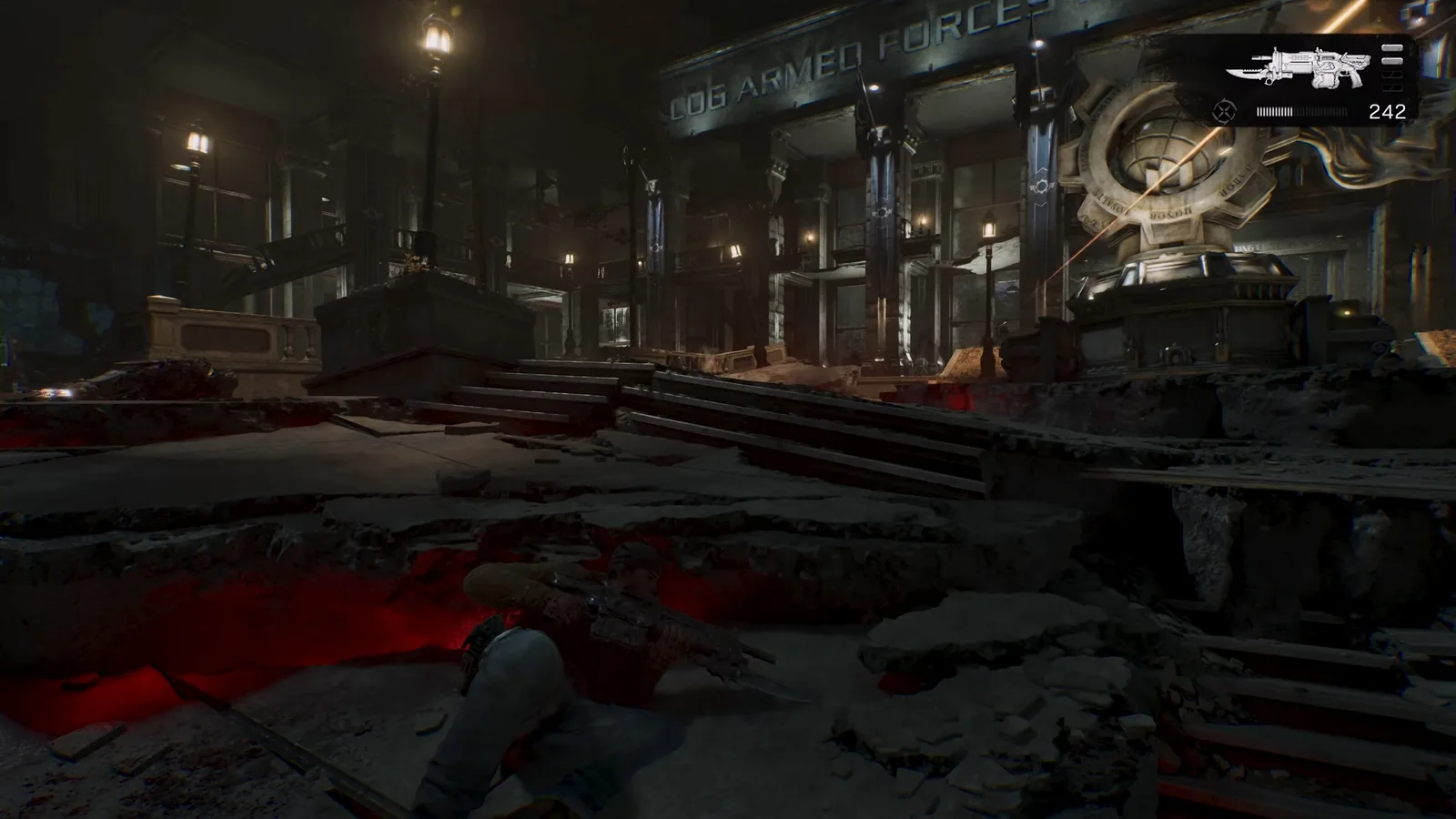
This scene illustrates low cover geometry. A still image does not demonstrate the input timing or completion of a cover cancel.
How the change affects fights against other players
The new timing gives movement clearer counterplay. Because a cancelling player travels farther toward cover, another player can follow the trajectory for longer. Because momentum delays a complete reversal, the point immediately after a cancel becomes a more understandable opportunity to respond. More consistent transitions also make it easier to judge where a player is facing, how far an action will carry them and when the next action can begin.
This does not mean standing still is safer or that cover cancelling has no competitive use. Entering cover remains fast, and a well-chosen cancel can still change the expected endpoint. The difference is that a repeated left-right chain advertises more of its rhythm. Once an opponent recognizes that rhythm, continuing it at the same cadence makes the next destination easier to predict.
Break predictable patterns by changing the route rather than merely accelerating the inputs. Complete one cover cancel, continue into a sprint, evade away from the obvious wall or use a slide when the geometry supports it. The purpose is to make a sequence of intentional choices, not to recreate legacy hyper-bouncing with a faster button press.
The timing standard to aim for
A successful E-Day cover cancel should look controlled: the character commits toward valid cover, escapes near the object, slows visibly and then moves into the chosen follow-up direction. If those phases remain readable while you link actions, the new rhythm is working.
Do not use the old 1.5-meter beta description as a mandatory launch benchmark, and do not judge the system by whether it reproduces Gears 5 movement. Judge it by consistency: you can identify the cancel window, finish the momentum transfer and select a useful next action without accidentally attaching to cover. That is the movement skill E-Day's rebuilt system rewards.