Start the Gnasher reload, watch the moving indicator, and use your reload input again when it reaches the timing target. E-Day reloads the Gnasher shell by shell, so you can load a round or two and return to the fight without waiting for the whole sequence. The standard magazine holds six shells. Learn the timing while protected, then decide whether the next situation calls for one usable shell or a full refill.
Use the timing bar rather than a memorized number of milliseconds. There is no verified current universal damage percentage, active-ammo duration, or one-shot distance to apply to every mode and enemy. Active reload and PvE Weapon Mods can influence your ammunition's effect, but a timed reload cannot compensate for a missed shot, an obstructed angle, or fighting beyond a useful range.
Find the timing bar before practicing speed
The active reload bar defaults to the center of the screen, below the reticle. A setting can move it to the upper-right corner. Choose the position you can monitor while still recognizing the nearby enemy and cover. Neither placement has an established performance advantage for every player.
Begin a reload in a safe area and observe the indicator moving toward the timing target. Use the same reload input again at the target rather than pressing repeatedly. Repeated taps make it harder to learn which input produced the result and can turn a simple timing exercise into guesswork.
Your reload button depends on your control scheme and remapping. Check the input shown in your current controls instead of assuming a tutorial's controller button is correct for your setup. Returning players should particularly avoid copying the exact button sequence from Reloaded or Gears 5 without checking E-Day's bindings.
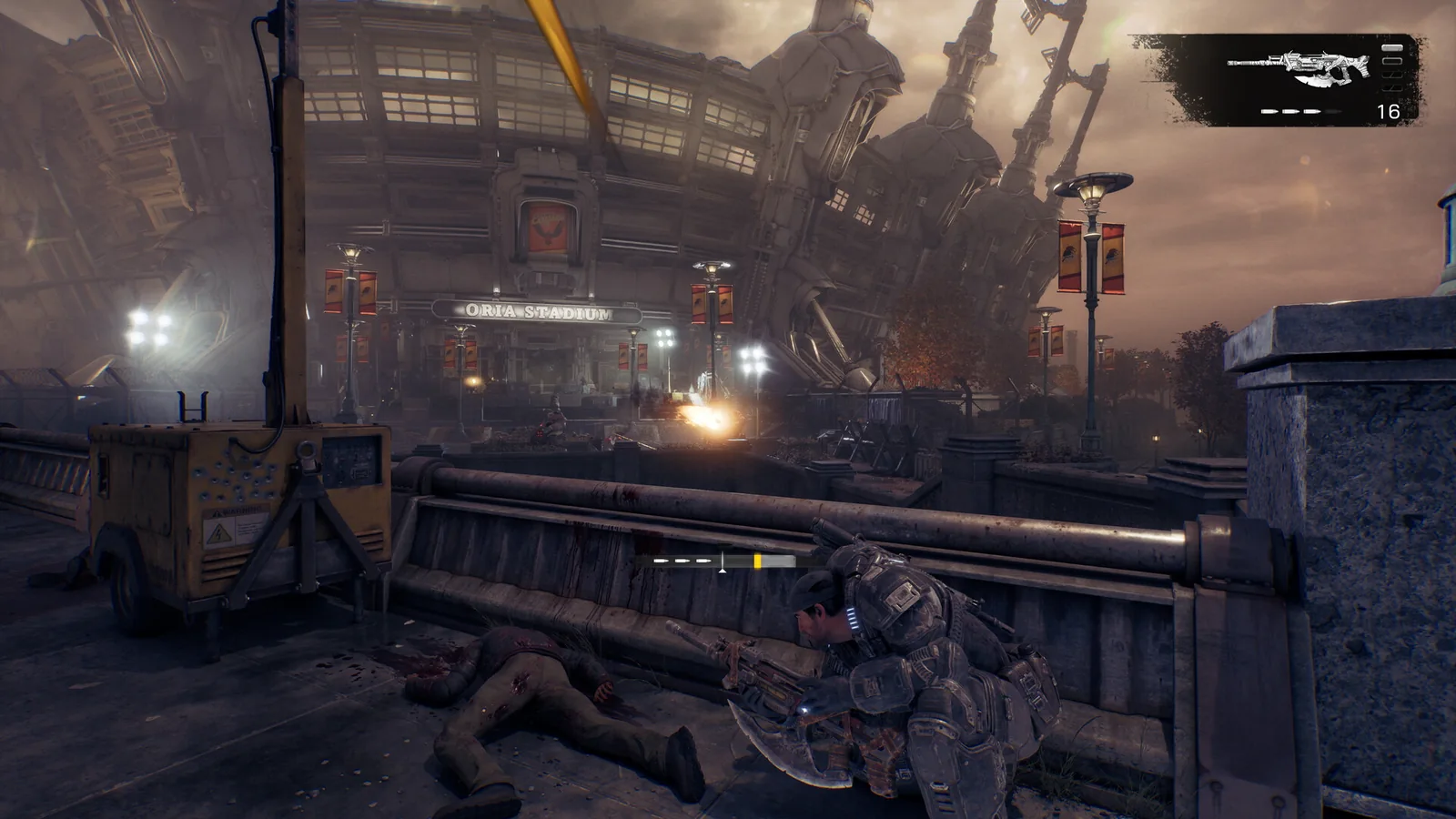
The shown weapon is a Breechshot, used here to locate the HUD reload bar. This image does not demonstrate Gnasher shell-by-shell loading.
The first goal is recognition: see the bar, identify the target, make one deliberate timing input, and observe the ammunition state. Speed comes after you can repeat that sequence. Moving the display or changing several controls at the same time can make it harder to identify which change improved your timing.
Understand the shell-by-shell decision
E-Day's Gnasher reload allows an immediate return after a limited refill. That creates a decision older magazine-based habits can obscure. You do not always have to wait until every missing shell has been loaded before answering an approaching enemy.
| Current situation | Reload goal | Reason |
|---|---|---|
| Safely between encounters | Restore the magazine | Enter the next fight prepared rather than almost empty |
| One close threat is approaching | Recover usable ammunition | A limited refill can restore an immediate answer |
| Protected behind a teammate's pressure | Refill while that opening lasts | Use the safe interval before the squad moves |
| Several enemies already control your position | Reach protection first when possible | Timing alone does not remove the incoming danger |
Watch the loaded-shell count as the sequence progresses. A completed timing action and a full magazine are not the same observation. Before you leave cover, verify that you have the amount of ammunition you intended to restore.
A partial reload is useful when the enemy's approach makes waiting for the full sequence unsafe. It is less useful as a permanent habit that leaves you short for every next encounter. Use safe gaps to restore the full magazine, and keep the limited refill for situations where it serves a clear purpose.
Practice the active input without adding movement
- Take the Gnasher into a safe practice situation.
- Fire enough ammunition that the reload has a visible purpose.
- Start the reload using your current binding.
- Watch the moving indicator approach the timing target.
- Use the reload input once at the target and observe the result.
- Check how many shells are loaded before returning to fire.
- Repeat until you can recognize the sequence without guessing.
Combat Training offers weapons and short Locust encounters for practice. Use the simplest repeatable situation first. You do not need a moving duel, a slide, and a cover cancel to learn the bar itself.
If the result is wrong, identify whether the second input came before or after the intended target. Correct that timing before increasing speed. Do not treat every failed result as an input-delay problem or immediately change the control scheme. The visible sequence should guide the adjustment.
Once the basic timing is familiar, practice recognizing it while watching a target. You still need to notice when an enemy enters the dangerous approach. The aim is to make reload timing require less attention, not to stare at the bar while the rest of the fight disappears.
Add partial reloads as a separate exercise
Begin with an incomplete magazine and practice loading only the ammunition needed for an immediate follow-up. Check the shell count and return to the target after the intended refill. Repeat the same amount so you learn the difference between a deliberate interruption and accidentally abandoning the reload too early.
Then compare that limited refill with a full reload. Note how the two options affect your ability to answer the next target. The goal is a decision you can repeat: short refill under pressure, full preparation when safe.
Avoid treating the familiar six-shell capacity as proof you always have six available. Shots, interrupted reloads, and weapon changes can leave a different count. The ammunition display is the condition that matters before a push.
Do not add a stopwatch target that the game has not established. Different conditions and weapon configurations can affect the sequence you are using. Practice the current on-screen behavior instead of trying to force a reload into a timing claim taken from an unrelated game.
Place the reload between decisions, not inside a panic
A good reload window begins with a reason the enemy cannot immediately punish it. Cover, a teammate's pressure, or the gap after a target has been removed can create that reason. Recognize the opening and prepare before moving toward the next fight.
After firing, check whether the enemy is still threatening your position. If you can return behind cover, do so before focusing on the timing bar. Standing in an open lane because you want a perfect reload can cost more than the ammunition advantage you hoped to gain.
When the squad prepares to push, reload before the push starts and tell teammates if you are not ready. Entering last because you began a refill at the same moment everyone moved can separate you from covering fire and support.
In a close duel, do not assume the opponent will give you the whole sequence. Use the shell-by-shell option when it answers the actual pressure, or switch to a usable weapon if that creates a better immediate response. Ammunition management includes changing the fight, not only changing the timing input.
Keep active effects separate from shot placement
A timed active reload can improve the weapon state, but the result still depends on the shot you take. A target behind cover, a partially aligned close shot, or a distant enemy will not necessarily behave like a training demonstration.
Gnasher aiming also has distinct rules. ADS uses the camera position, while hip fire uses E-Day's hybrid camera-and-muzzle approach. Do not attribute every changed hit to the reload when you also changed aiming mode, distance, or angle.
If you want to compare ordinary and active-ammo shots, keep the target, range, mode, and weapon configuration the same. Change only the reload state you are examining. A single online duel is too uncontrolled to establish an exact damage increase or a universal kill threshold.
Avoid firing into the same protected area repeatedly simply because the ammunition is active. Look for a clear target or another route. Your improved weapon state should support a good shot, not persuade you to keep taking a poor one.
Check PvE modifiers before relying on an active-ammo setup
Campaign and Horde Siege have Weapon Mods that can change ammunition effects. Those choices are separate from the physical task of timing the reload. Read the equipped perfect-ammo effect and decide how your current weapon is meant to use it.
A damage-oriented choice rewards a particular ammunition state, while other weapon effects can change how the weapon behaves. Do not assume every perfect reload across all weapons supplies the same bonus. The Hammerburst, for example, has a perfect active reload effect that increases fire rate; that is not a universal description of the Gnasher.
Horde mission modifiers can also affect reloading conditions. Read the mission's displayed rules before relying on a build that requires a particular reload result. A reload-dependent setup should remain usable when the mission changes the conditions you expected.
Versus has no Weapon Mods and begins with equal loadouts. Keep a standard-weapon PvP practice result separate from a customized Horde or Campaign shotgun. Applying the same supposed damage percentage to both would erase the configuration and mode conditions that make the comparison meaningful.
Combine the reload with cover movement only after timing is stable
Practice moving to cover, reloading, then leaving toward a visible target. Keep the route simple enough to know where your character will finish. Add sliding or climbing later, after you can preserve awareness of both the bar and the destination.
E-Day movement uses commitment and momentum, and launch tuning adjusted cover entry, cancel behavior, and slide distance. A reload sequence copied from an older movement rhythm may not leave you in the same position. Learn the current transition instead of assuming an old cancel will always protect the timing window.
Do not begin a complicated movement simply to prepare active ammunition. If the route exposes you to more enemies or pulls you from squad support, the setup costs more than it provides. Prepare the weapon at the protected position you already have when possible.
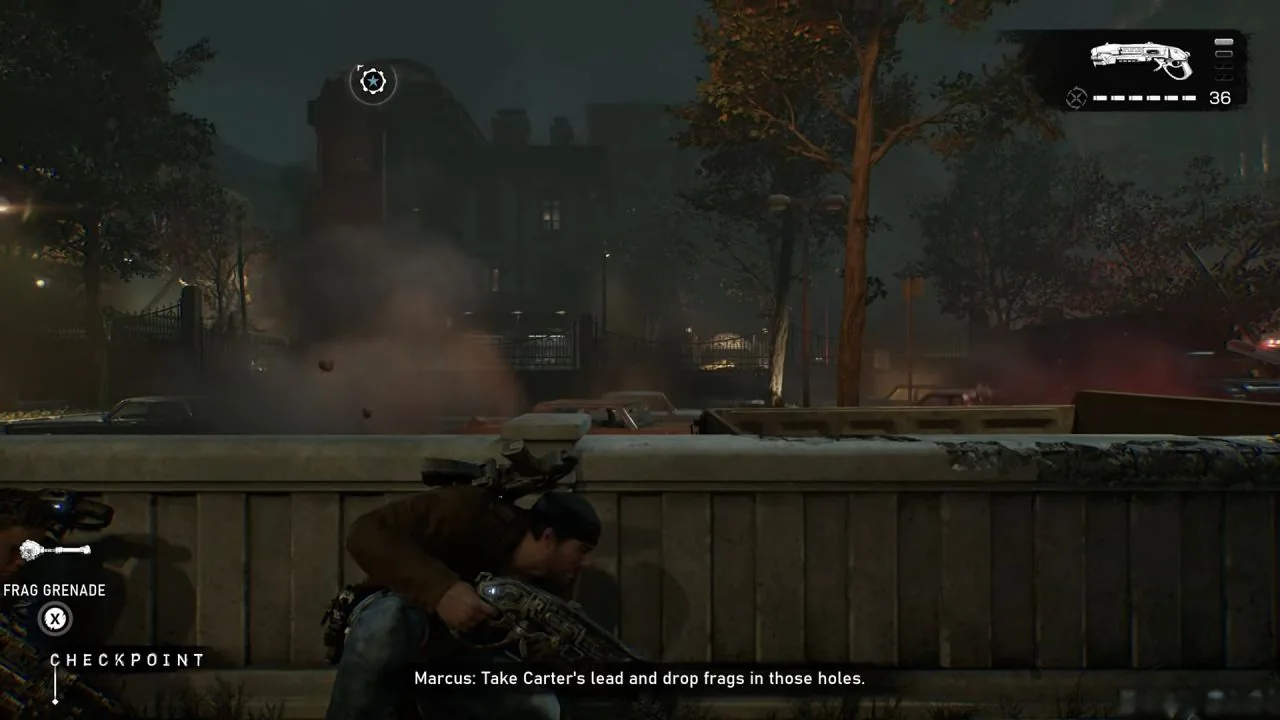
This protected posture illustrates a place to pause before reloading. The screenshot does not show a Gnasher reload in progress.
The most useful combined routine is short: identify the next cover, restore the ammunition you need, move with the squad, and take a clear shot. More inputs are only useful when they improve that sequence rather than distract you from it.
Fix the visible failure in the sequence
| Problem | Check first | Next adjustment |
|---|---|---|
| Timing repeatedly fails | Position of the indicator at the second input | Practice without movement and correct early or late timing |
| Reload succeeds but ammunition is still short | Shell count when you returned to fire | Give the refill enough time for the intended number of shells |
| You get shot while watching the bar | Protection and enemy approach | Move to a safer window before practicing the input |
| Damage seems different after a reload | Target, distance, aim, mode, and mods | Compare equivalent shots before inferring a bonus |
| The button does something unexpected | Current control scheme and binding | Confirm the actual reload input |
If you suspect a repeated input issue after a controlled comparison, keep a recording of the visible bar and your result. This helps distinguish a mistimed input from an abnormal sequence. A failed reload alone does not prove a game-wide bug or a hardware fault.
Use a prepared weapon for the next engagement
Before the next fight, check the magazine rather than relying on memory. If the squad is moving and the weapon is short, use the safe interval to refill. If an enemy is already approaching, decide whether a limited reload, a weapon switch, or movement to cover gives the best response.
The reliable habit is not hitting a timing target at any cost. It is entering useful fights with ammunition, recognizing the small window when one more shell is enough, and refusing to let the reload bar pull your attention away from an enemy who can already punish the attempt.