There is no verified fastest class-XP farm, proven best class, or trustworthy XP-per-hour benchmark for Gears of War: E-Day. The most defensible route is to complete Horde Siege missions consistently, stay active in objectives, take worthwhile secondary objectives, and play the highest difficulty your squad can finish reliably. Standard Siege is a practical default because it offers several objectives in a 20–40 minute mission, but it has not been proven to beat every Blitz or Horde run on an XP-per-minute basis.
Completion matters more than selecting the hardest option on the menu. Every completed Horde Siege mission awards Class XP, while a failed mission awards only partial XP. A coordinated squad that repeatedly extracts on a manageable difficulty will usually make steadier progress than one that overreaches, wipes, and restarts.
The class-XP system in one minute
Class XP belongs to Horde Siege class progression. At launch, Assault, Breacher, Marksman, and Medic each have their own 30-level track. Completing a mission advances the class used for that mission, so changing classes spreads your play across separate tracks instead of concentrating progress on one.
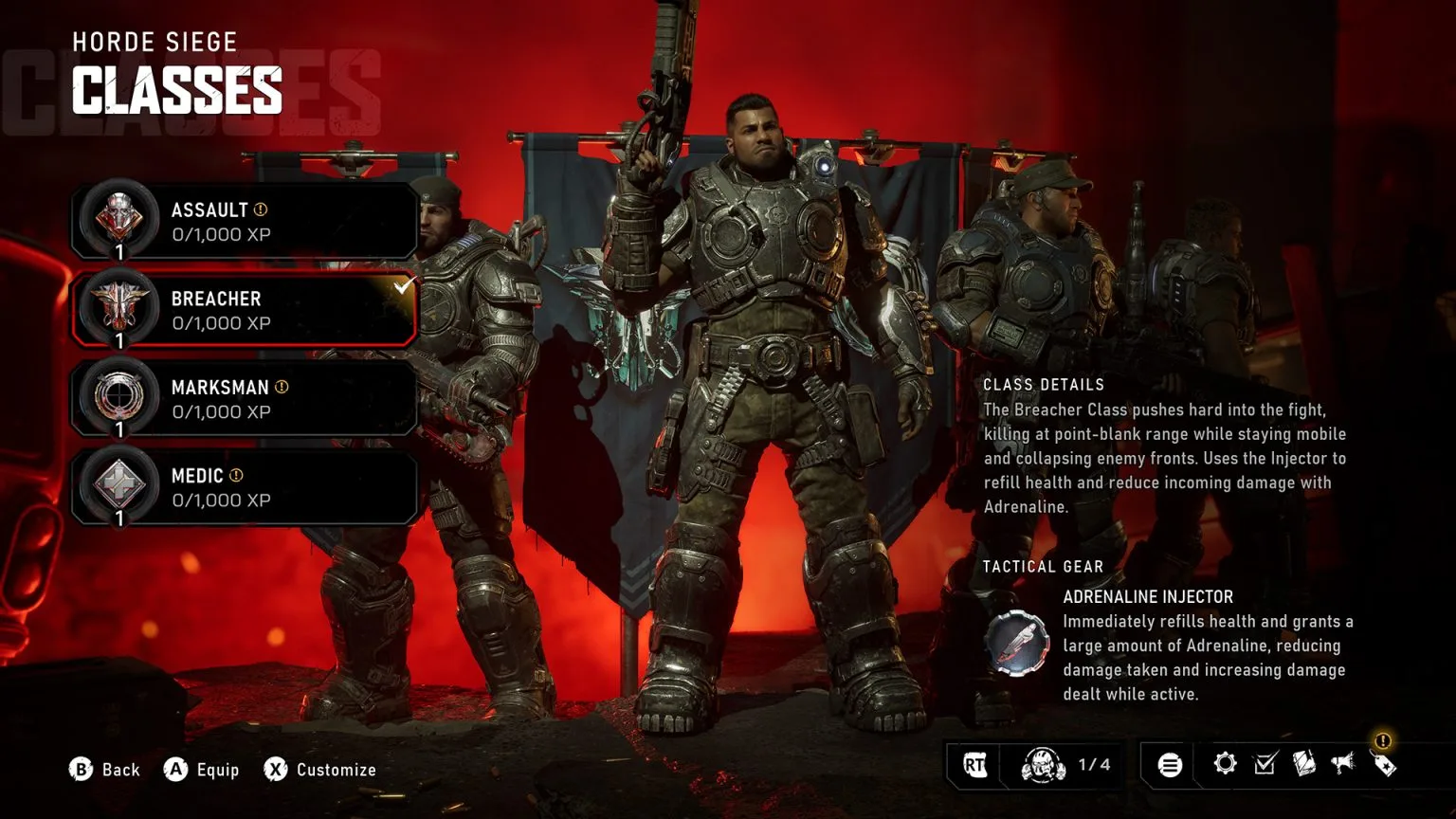
The class menu shows individual class selection and XP progression.
Do not confuse Class XP with the other progression systems shown around multiplayer:
| Resource or progression | How it is earned or used | Why the distinction matters |
|---|---|---|
| Class XP | Awarded for completed Horde Siege missions; failed missions provide partial XP | This is what advances the selected class through its 30 levels |
| Player XP | Earned from multiplayer matches and weekly challenges in Horde Siege and Versus | This advances the account-level track toward level 100 and Re-Ups, not the selected class track |
| Energy | Collected during a Horde Siege mission and shared when earned by the squad | It supports the current run and contributes to mission score; it is not persistent Class XP |
| Weapon Parts | Obtained through progression and Horde Siege rewards | These purchase unlocked Weapon Mods; collecting them is a separate goal from leveling a class |
| Coins | Earned through multiplayer performance, Player Level milestones, and medals | These are used for customization items and do not advance a class level |
This separation prevents a common mistake: completing a weekly challenge may visibly award Player XP without being a special Class XP shortcut. Weekly challenges are useful for account progression, but the confirmed foundation of class leveling is finishing Horde Siege missions with the class you want to advance.
Turn each mission into a clean XP run
Use this repeatable route instead of looking for an unsupported exploit or a fixed farm number:
- Commit to the class you actually want to level. Each class has an individual progression track. If your immediate goal is one unlock on one class, keep playing that class until you reach it rather than rotating after every match.
- Select a mission length your squad can finish without rushing. Standard Siege is a practical starting option when your squad has time for multiple objectives and movement across the map. Blitz is valid when you need a shorter commitment, while Horde asks you to survive ten waves and can last much longer.
- Choose difficulty by completion reliability. Use the game’s suggested difficulty as the starting signal. Moving up is worthwhile only when the extra challenge does not turn regular completions into repeated partial-XP failures.
- Stay involved in the main objective. Horde Siege score rewards active participation, including objective play, kills, and assists. Do not abandon the assigned R.I.G. task merely to search distant corners of the map.
- Complete secondary objectives selectively. They add combat and travel but can improve the run’s rewards and score. Take them when the squad has enough time, lives, and momentum to finish the main mission afterward.
- Regroup after a costly fight. If the squad is losing lives, change tactics before starting optional work. COG Resupplies, collected Energy, equipment, and Squad Perks can strengthen the current run, but only if pursuing them does not create another wipe.
- Protect the final extraction. After completing the main objectives, clear the landing zone and board the Raven in time. Only one member of your squad technically needs to extract for the mission to count as completed, so preserving one safe route is more important than chasing unnecessary final kills.
- Repeat the same successful setup before changing variables. Consistent mission type, difficulty, and squad coordination make it easier to judge whether a route is genuinely efficient for you.
A premade squad can make this loop more dependable because players can coordinate roles, decide whether a secondary objective is worth the risk, and regroup before consuming the remaining squad lives. A premade team does not receive a documented Class XP multiplier; its advantage is the potential to complete objectives and missions more efficiently.
Horde Siege is a 12-player battlefield containing three squads, so not every event is under your squad’s control. Other squads may affect the battlefield, leave equipment behind, or join an Invasion Event. Treat those changing conditions as reasons to make a fresh risk decision rather than forcing the same route in every match.
Choose the mission type by completion efficiency
The three mission playlists differ in length and structure. None comes with a verified official Class XP-per-minute figure, so the best selection depends on how reliably your squad converts its available time into completed missions.
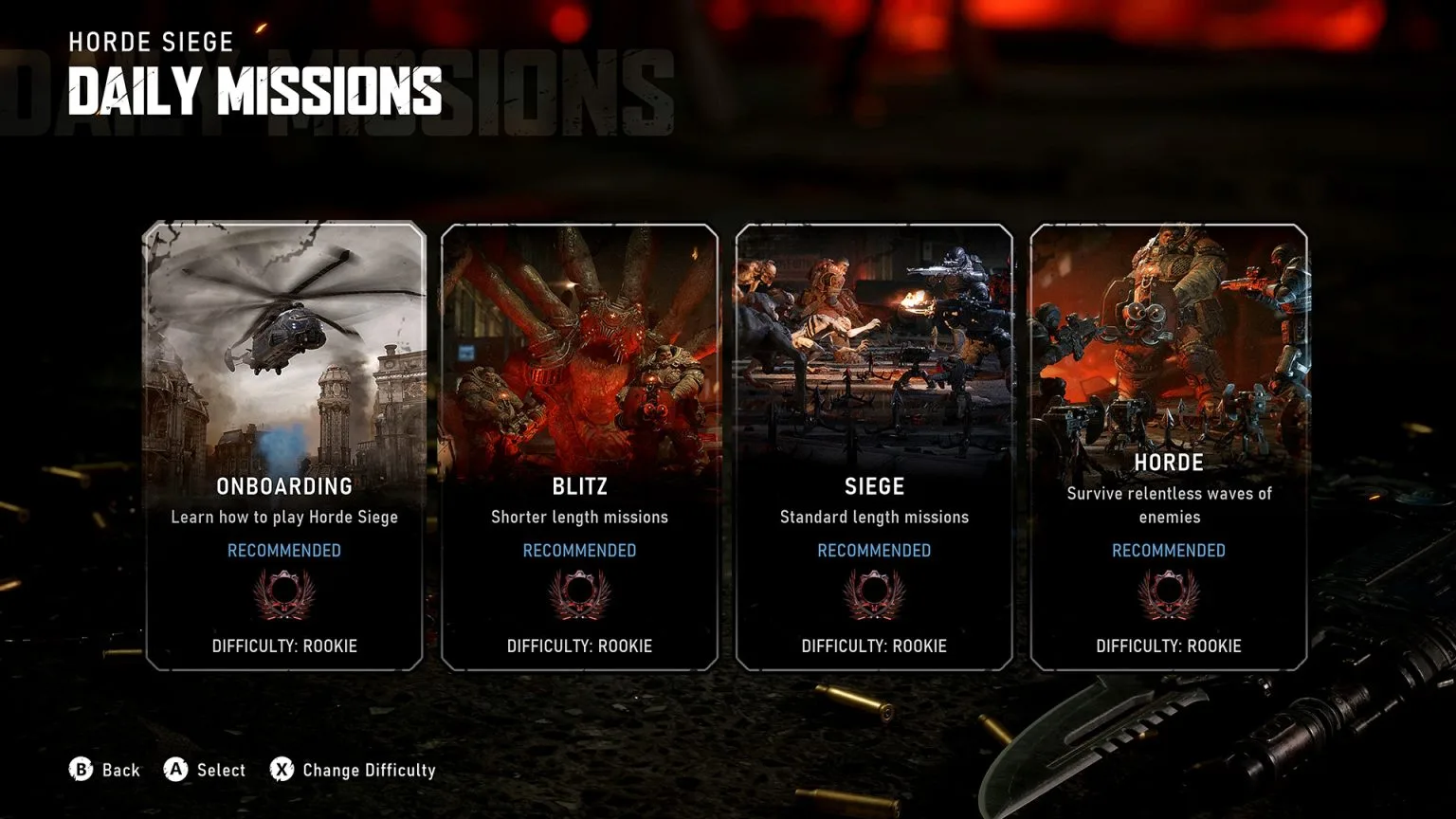
The mission menu presents the available Horde Siege completion routes.
| Playlist | Confirmed structure | Typical stated length | Class-XP use case |
|---|---|---|---|
| Blitz | One or two objectives | About 15–20 minutes | Useful for short sessions or when a shorter mission improves your chance of finishing |
| Siege | Multiple objectives with more movement across the map | About 20–40 minutes | Practical default for active objective play and optional secondary objectives |
| Horde | Ten defensive waves with limited support | Up to about 50–60 minutes | A longer, tougher commitment; do not assume its duration automatically means better XP per minute |
Standard Siege is a useful route to compare first when its mission length fits your squad, but its objective count does not establish a universal Class XP-per-minute advantage. If your squad repeatedly fails a 40-minute Siege attempt but reliably completes Blitz, the shorter playlist can preserve more of your session for completed-mission rewards. Conversely, a coordinated squad that clears Siege smoothly can benefit from its larger objective set without spending the full possible duration.
Horde can still advance a class because it is a Horde Siege mission, but its ten waves create a longer exposure to mistakes and resource pressure. Choose it because your squad can complete it efficiently or enjoys that structure, not because the longest playlist must award the fastest Class XP.
Use difficulty as a completion filter
Higher Horde Siege difficulties offer increased rewards, but they also introduce a greater failure risk. The current recommendations tied to class progression are:
- Infantry: recommended for class levels 10–20.
- Commander: recommended for class levels 20–30.
- Allfather: recommended only for max-level classes.
For a class below level 10, follow the difficulty suggested by the live mission interface rather than forcing Infantry based on an old or conflicting threshold. The final selection belongs to you and your squad, but the recommendation exists to keep class strength and mission pressure reasonably aligned.
Do not move to Commander merely because the option is available. First check whether your squad can still complete main objectives, preserve squad lives, and extract consistently. The extra rewards of a harder setting are poor compensation if most attempts end in partial XP. Likewise, Allfather is not a leveling shortcut for an unfinished class: it is explicitly positioned for max-level classes.
A simple promotion rule is to move up only after the current difficulty feels repeatable rather than barely survivable. If the next setting causes frequent wipes, drop back, gain class levels and unlocks, then test it again later. This is a completion-efficiency rule, not a claimed hidden XP formula.
Use objectives without sacrificing the completion
Most missions revolve around R.I.G.s and one or more main objective types:
- Secure requires the squad to enter an occupied area and remove the Locust presence.
- Calibrate requires defending a series of zones around a R.I.G.
- Repair requires recovering scattered components and reinstalling them.
- Defend requires holding an active R.I.G. until its mapping sequence finishes.
- Horde requires defending one R.I.G. through ten increasingly difficult waves.
Your first priority is always the main assignment because the route to full Class XP is a completed mission. Secondary Objectives are shorter optional tasks such as defusing explosives, eliminating a High Value Target, collecting COG intel, or delivering a Power Core to another squad’s R.I.G. They can provide bonus rewards, Energy, equipment, or Squad Perks and can raise the value of an otherwise controlled run.
The correct time to accept one is when the squad has enough lives, ammunition, time, and positioning to return to the main objective. Skip or abandon optional work when an active Invasion Event blocks extraction, a main objective is under pressure, or several teammates need to be revived. Optional score is not efficient if it turns a likely completion into partial XP.
Energy supports this decision loop. Completing objectives and defeating enemies adds to the squad’s shared Energy pool. Individual players can spend it at Supply Caches on equipment, grenades, class-appropriate options, or Squad Perks, while certain defensive positions allow turret purchases and upgrades. Energy also contributes to mission score, but it expires as an in-session resource rather than becoming Class XP after the match.

The R.I.G. is the mission-critical device tied to objective completion.
Death does not immediately remove a player from the mission. A fallen player drops COG tags, which squadmates can deliver to a Supply Cache for a revive; players from another squad can also collect those tags for an immediate revive. A full squad wipe consumes a squad life, and using every squad life fails the mission. Recovering tags and regrouping can therefore protect the completed-mission reward more effectively than continuing an uncoordinated push.
Measure your own fastest repeatable route
Because there is no controlled XP-per-hour benchmark, you can compare routes without pretending one result applies to every squad. Record only a few visible results after each run:
- Class level or Class XP before and after the mission.
- Playlist and selected difficulty.
- Approximate mission duration.
- Whether the squad completed and extracted or failed for partial XP.
- Number of secondary objectives attempted and completed.
- Whether you played with a coordinated group or matchmaking teammates.
Compare several successful runs under similar conditions. A single unusually fast match, late join, difficult Invasion Event, or early wipe is not enough to establish a farm. The useful measure is repeatable progress across the time you actually spend playing, including failed attempts and matchmaking delays.
Change one major variable at a time. For example, keep the same class, squad, and difficulty while comparing Blitz with Siege. Then keep the preferred playlist and test whether a higher difficulty still produces reliable completions. This approach will reveal the best route for your squad without inventing universal XP values.
Do not use Player Level gains, Coins, Energy collected, or Weapon Parts extracted as a substitute for the Class XP result. Those values can rise at different rates and serve different progression systems.
What class levels unlock
Each launch class has 30 levels. Advancing the track unlocks new loadout weapons and equipment, Armor Mods, Tactical Gear Mods, and unique Weapon Mods. Key milestones also provide base health and damage increases. These unlocks can make later missions more manageable, which is another reason to use a stable difficulty progression instead of immediately forcing the highest available option.
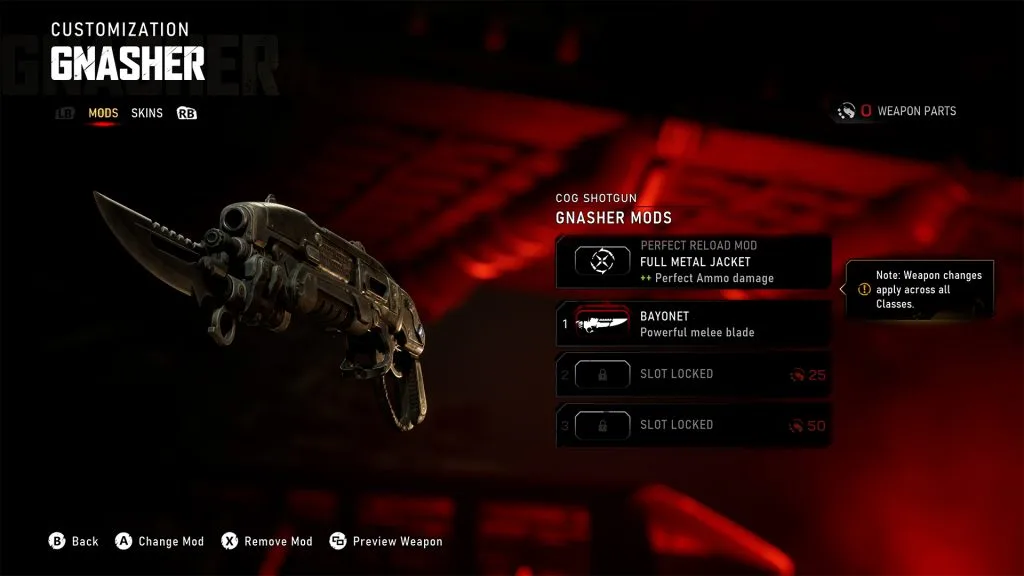
The loadout screen shows where weapon-mod rewards are reviewed.
Armor Mods can adjust attributes such as health, ammunition reserves, or weapon-swap speed and may add more specialized effects. Tactical Gear Mods improve the selected class’s unique equipment through changes such as shorter cooldowns, greater range, or added effects. Weapon Mods first become available on a class-level track and then require Weapon Parts before they can be equipped.
Weapon customization is shared across classes when the same weapon is equipped, but Class XP is not described as shared. A modded weapon can therefore support another class later without making that class inherit the original class’s level progress.
Avoid the common Class XP traps
- Do not treat Player XP challenges as Class XP boosts. Weekly challenges award Player XP and feed the separate level-and-Re-Up system.
- Do not copy an unsupported level-15 jump to Commander. The current class-level recommendation places Commander at levels 20–30.
- Do not assume the hardest difficulty is automatically fastest. Failed missions provide partial XP, so failure frequency belongs in any efficiency comparison.
- Do not equate a long mission with a high hourly rate. Horde can last up to 50–60 minutes, but no verified benchmark proves it beats shorter completed missions.
- Do not chase every secondary objective. Optional rewards help only while the main mission and extraction remain under control.
- Do not expect one class to have a documented XP advantage. The four classes have different roles and progression tracks, but no published evidence here establishes a class-specific XP multiplier.
- Do not rotate classes accidentally. If you want one class-level unlock, confirm the selected class before queueing so the completed mission advances the intended track.
The safest fast-leveling routine is therefore straightforward: focus one class, begin with a reliably completable Horde Siege playlist, respect the class-level difficulty recommendations, contribute to every main objective, add secondary objectives only when conditions allow, and protect the extraction. Use your own repeated results to decide whether Blitz, Siege, or a higher difficulty improves progress; no universal numerical farm has yet been established.