As of October 9, 2026, the Gears of War: E-Day Metacritic page shows a Metascore of 87 for Xbox Series X and 82 for PC. Metacritic labels both results Generally Favorable, but the five-point gap means you should select the platform you actually plan to play before using the score as part of a buying decision.
The page also shows an 8.4 user score for Xbox Series X. That number is separate from the 87 Metascore: critics use a 100-point presentation, while the displayed user score uses a 10-point scale. Converting 8.4 into 84 may make the numbers easier to compare visually, but it does not turn them into results from the same group or the same rating system.
Current Metacritic Scores by Platform
| Platform | Critic Metascore | Metacritic label | User score shown |
|---|---|---|---|
| Xbox Series X | 87 | Generally Favorable | 8.4 |
| PC | 82 | Generally Favorable | Not established here |
These are platform-specific results, not two competing answers for a single universal score. If you are playing on Xbox Series X, 87 is the relevant critic aggregate. If you are buying the Windows or Steam version, 82 is the relevant result. Quoting only the higher number without naming its platform can mislead a PC buyer, while quoting only 82 understates the Xbox result.
The page lists Xbox Series X and PC as its available platforms and gives October 6, 2026 as the initial release date. No PlayStation score is shown. That matches the currently confirmed release platforms, which include Xbox Series X|S and Windows PC, including Steam. It does not establish a future PlayStation release or score.
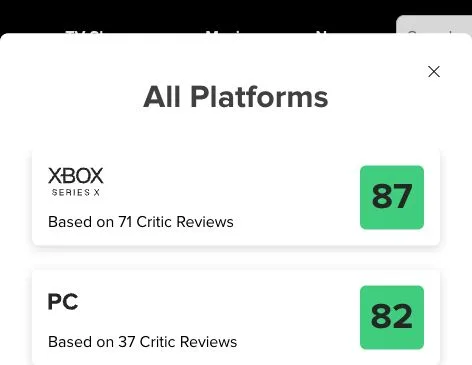
Metacritic scores as displayed on October 9, 2026. Review totals differ between the site's summary and platform views.
Why Xbox and PC Have Different Metascores
A platform Metascore summarizes the critic ratings associated with that platform. The Xbox Series X result and PC result therefore come from separate platform views. They should not be averaged together, swapped freely, or described as if one has replaced the other.
The five-point difference does not identify its own cause. It does not, by itself, prove that the PC version performs worse, contains less content, or received harsher reviews because of a particular technical problem. Metacritic’s platform views show the two scores without establishing a controlled cause for the gap.
Different platform results can also reflect which reviews appear in each platform pool. A reader should therefore use the score attached to the intended platform and then inspect individual reviews for the concerns that matter personally. Someone choosing PC may care about PC-specific performance observations, while an Xbox buyer may place more weight on the console experience. The aggregate number alone cannot answer either question in detail.
Do not describe Gears of War: E-Day as having a single unqualified Metacritic score unless the platform is clear from context. The safest compact wording is: 87 on Xbox Series X and 82 on PC as of October 9, 2026.
What an 87 Metascore Actually Tells You
The Xbox Series X Metascore of 87 indicates a strongly favorable overall critical reception on that platform. It is useful as a quick consensus signal, especially when deciding whether the release broadly met reviewers’ expectations. It is not equivalent to saying every critic gave the game an 87, that 87 percent of reviewers recommend it, or that the game is objectively 87 percent perfect.
The review excerpts displayed on the page show why the average needs context. Some critics awarded extremely high scores and described the release as a major return for the series. Others were more reserved, including a displayed score as low as 50, with complaints about repetition, filler, story emphasis, or the balance between linear action and broader exploration. An 87 can coexist with that disagreement because an aggregate condenses many separate verdicts into one number.
The score also does not reveal whether an individual reviewer evaluated only the campaign or spent substantial time with multiplayer. Several of the listed reviews were explicitly marked as reviews in progress, often because multiplayer access or testing was incomplete at the time. Those provisional impressions should not be treated as identical to finalized, full-package reviews.
Use 87 as evidence that the Xbox version received broadly strong reviews, then use the review spread to decide whether the recurring reservations overlap with your own priorities.
Metascore and User Score Use Different Scales
The Xbox page displays two prominent numbers:
- 87 Metascore: the critic result presented on a 100-point scale.
- 8.4 user score: the audience result presented on a 10-point scale.
They are not interchangeable. Multiplying 8.4 by ten produces 84 for an informal visual comparison, but it does not create a critic-style Metascore. The two results come from different groups, and a matching or near-matching number would not prove that critics and users reached their judgments in the same way.
User scores can also change as additional people submit ratings. The displayed 8.4 is a dated snapshot, not a permanent promise. When sharing it, attach the platform and date just as you would for the critic score: 8.4 user score on the Xbox Series X view as of October 9, 2026.
The PC score should not be paired with the Xbox user score as though both describe the same platform sample. Keep the PC critic result separate from the Xbox audience rating. The table focuses on the verified 82 PC Metascore and leaves its audience field unspecified; it does not import the Xbox user rating into the PC view.
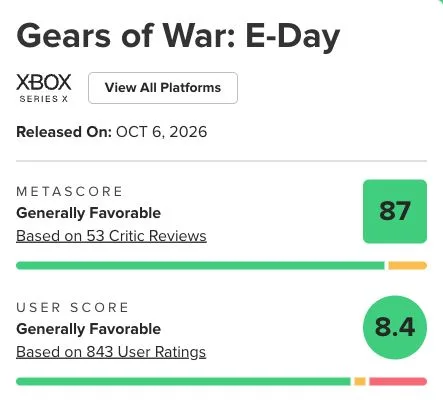
Metacritic scores as displayed on October 9, 2026. Review totals differ between the site's summary and platform views.
What the Review Spread Adds to the Average
The individual reviews reveal a more useful pattern than the headline number alone. Positive excerpts repeatedly praise the cover-based shooting, weighty combat, visual presentation, expanded movement, action sequences, and the return to a darker Gears atmosphere. Several critics also describe the campaign as a strong entry point for newcomers while retaining the identity longtime players expect.
The reservations are not all about the same issue. Displayed lower-scoring and mixed reviews criticize repetition, less engaging open or exploratory sections, uneven pacing, side content, and a story that some reviewers felt did not devote enough attention to Marcus and Dom. Other critics praised the characters and story, so the narrative response is visibly less uniform than a single average suggests.
That disagreement is useful when reading the 87 and 82. A player primarily interested in familiar Gears gunplay may find the positive consensus highly relevant. A player buying mainly for a tightly focused Marcus-and-Dom story should read the narrative reservations more carefully. Someone interested in the complete multiplayer package should distinguish finalized reviews from campaign-only or in-progress coverage.
None of those themes changes the displayed Metascores. They explain why two readers can see the same 87 and reach different purchase decisions. The aggregate answers whether the overall reception was favorable; the review spread helps answer whether the reasons for that reception match what you want from the game.
How to Use the Scores Before Buying
-
Choose your platform first. Use 87 for Xbox Series X and 82 for PC. Do not select the higher score simply because it is more favorable if you intend to play the other version.
-
Separate critic and audience results. Treat 87 and 8.4 as two different signals on two different scales. The user score adds audience context, but it neither confirms nor overturns the critic result by itself.
-
Identify the part of the package you care about. The excerpts cover campaign, competitive multiplayer, Horde Siege, visuals, movement, exploration, and story. A high overall score cannot guarantee that every one of those elements will suit you equally.
-
Check whether a verdict was final. Some early coverage was labeled as a review in progress or focused specifically on the campaign. A score based on completed campaign play is still useful for campaign questions, but it should not automatically be treated as a final assessment of every online mode.
-
Read both favorable and critical excerpts. The strongest praise centers on combat, presentation, movement, atmosphere, and the return of the series’ familiar identity. The most relevant reservations include repetition, broader exploration, pacing, side content, and story focus.
-
Keep the date attached. Metacritic pages can change as ratings and reviews are added or reorganized. The figures on this page describe the ratings displayed on October 9, 2026.
-
Use store information for purchase details. Metacritic is useful for reception, but it is not the correct source for current regional prices, ownership rules, Game Pass access, upgrade eligibility, or edition contents. Those questions belong to the relevant store and edition listings.
Following this sequence prevents the most common mistake: treating one large number as a complete recommendation for every platform, mode, and type of player.
Common Metacritic Misreadings to Avoid
-
Calling 87 the universal score: It is the Xbox Series X Metascore. PC is listed separately at 82.
-
Calling the PC version poorly reviewed: Metacritic labels the 82 PC result Generally Favorable. It is lower than the Xbox result but still favorable within the page’s displayed classification.
-
Treating the five-point gap as proof of technical quality: The score difference alone does not establish frame rate, stability, visual settings, hardware demands, or the cause of any platform-specific criticism.
-
Describing 8.4 as another Metascore: It is the Xbox user score and uses a different scale from the critic result.
-
Converting 8.4 to 84 and claiming critics and users agree: The arithmetic may help visual comparison, but the underlying groups and rating systems remain separate.
-
Using the score as a campaign-length estimate: Metacritic reception does not answer how long the campaign takes. Length belongs to a separate, purpose-built guide.
-
Using it as a performance specification: The aggregate cannot confirm a selectable 120 FPS console mode or any particular PC configuration. Those require platform and technical evidence.
-
Assuming every review covers the same content: Some cited coverage focused on the campaign or remained in progress while multiplayer evaluation was incomplete.
-
Treating user reviews as a representative survey of every player: The displayed audience score summarizes participating raters on that platform view; it does not measure every owner’s opinion.
-
Assuming the score will never move: These figures describe the page on the stated date. Later additions or page changes may produce different displayed values.
What the Metacritic Scores Cannot Decide for You
Neither 87 nor 82 tells you which edition to buy, whether an upgrade includes the base game, whether a historical early-access benefit still has value, or what the title costs in your region. The scores also do not establish Steam-to-Xbox cross-buy rights, a PlayStation release, current server conditions, or a particular PC performance result.
They also cannot resolve preference-driven disagreements in the reviews. Critics differ on the story, exploration, pacing, repetition, and how successfully the game balances familiar Gears design with newer additions. An aggregate preserves the overall direction of reception while hiding much of that disagreement.
The most defensible conclusion is narrow but useful: professional reception was strongly favorable on Xbox Series X and favorable on PC in the October 9 ratings. Players who prioritize combat, presentation, and classic Gears identity will find substantial positive support in the displayed reviews. Players most concerned about repetition, exploratory sections, or story focus should look beyond the average and weigh those recurring reservations before deciding.
Choose the rating for your platform
The current Gears of War: E-Day Metacritic comparison is 87 for Xbox Series X and 82 for PC, with both platforms labeled Generally Favorable. The Xbox view also shows an 8.4 user score, which must remain separate from the critic result.
Use the number attached to your platform, treat it as a consensus signal rather than a complete verdict, and read the review spread for the features that matter to you. The supported short answer is simple: E-Day received favorable aggregate reviews on both listed platforms, with the stronger displayed critic score on Xbox Series X.