
As of October 10, 2026, the Gears of War E-Day OpenCritic snapshot shows an 87 Top Critic Average, 92% Critics Recommend, 89 critic reviews, and a 98th-percentile ranking. Together, those figures indicate a strong critical reception on OpenCritic, but they do not all measure the same thing. The 87 is the aggregate critic average, 92% is a recommendation rate, 89 is the number of critic reviews reported with the aggregate, and the percentile describes the game's position within OpenCritic's wider catalog.
Treat all four figures as a dated snapshot rather than permanent launch statistics. Additional reviews or changes to the aggregation can alter the average, recommendation percentage, review count, or percentile. These are OpenCritic figures, not platform-specific scores from another review aggregator, and they should not be relabeled or combined with numbers from a different service.
The October 10 OpenCritic snapshot
| OpenCritic field | Displayed value | What the value tells you | What it does not tell you |
|---|---|---|---|
| Top Critic Average | 87 | The aggregate critic score displayed for the game | A user score, a personal verdict, or a platform-specific score |
| Critics Recommend | 92% | The share represented by OpenCritic's recommendation metric | A score of 92 out of 100 or proof that every review awarded a high numerical rating |
| Critic reviews | 89 | The review count reported with the aggregate snapshot | Necessarily 89 directly comparable numerical scores |
| Percentile rank | 98th percentile | The game's relative placement among games scored on OpenCritic | A 98 out of 100 review score |
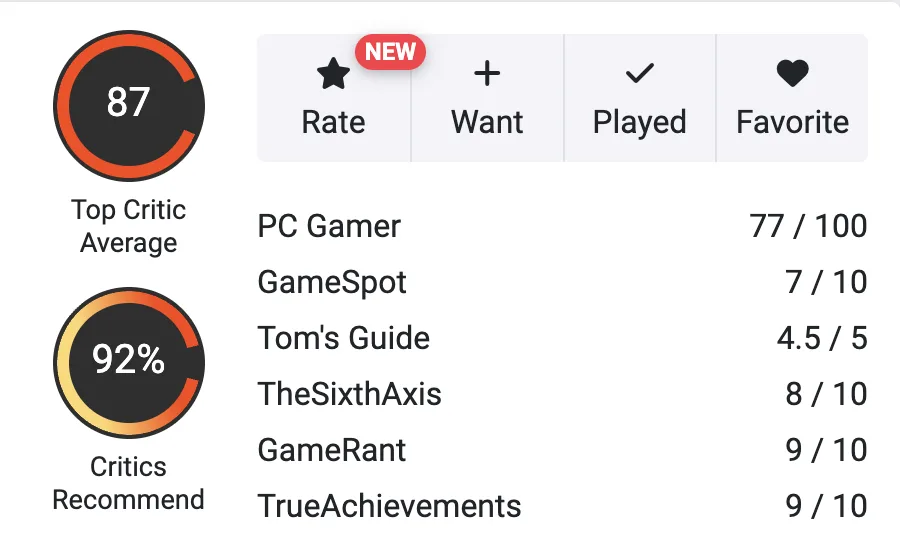
October 10, 2026: the average score and recommendation percentage are separate measures.
The safest short reading is: OpenCritic reported a high average, a high recommendation rate, and a high relative ranking across 89 critic reviews in the October 10 snapshot. That captures the available evidence without turning separate fields into one invented score.
The date matters because an aggregation page is a changing record. A reader who sees a different count later has not necessarily found an error. The page may have incorporated more reviews since this snapshot. For the same reason, quote the four values together with their date when preserving or comparing the result.
What the 87 Top Critic Average means
The 87 Top Critic Average is the headline numerical aggregate shown on the OpenCritic charts page. It is the figure to use when someone asks for the game's OpenCritic average. Write it as 87, or as an 87 Top Critic Average, rather than silently changing it into a platform score or a player rating.
The average is useful because it condenses the scored critical coverage into one readable number. It does not mean every critic gave the game an 87, and it does not show how tightly individual scores cluster around that value. The published review list includes multiple scoring scales, including ratings expressed out of 10, 20, 100, five stars, and percentages. OpenCritic presents the normalized aggregate so readers do not have to compare those raw formats as if they were identical.
An aggregate also cannot describe every disagreement behind it. Two games could display the same average while having different mixtures of enthusiastic, moderate, and negative reviews. Use the 87 to answer the aggregate-score question, but do not stretch it into a claim that critical opinion was unanimous.
What the 92% Critics Recommend figure means
The 92% Critics Recommend figure is a recommendation metric, not a second review score. It answers a different question from the Top Critic Average. The average summarizes normalized scored reception, while the recommendation percentage summarizes how frequently the coverage counted by OpenCritic falls on the recommending side of its system.
That distinction explains why the page can show an 87 average and a 92% recommendation rate without any contradiction. One number reflects score magnitude; the other reflects recommendation status. A review does not need to award exactly 92 out of 100 for the recommendation figure to be 92%.
Do not multiply 89 by 92% and present the result as a confirmed number of positive reviews. The displayed page contains both scored and unscored review formats, and the dated snapshot does not establish the exact denominator or rounding procedure behind the percentage. The supported value is the published 92%, not a reconstructed critic tally.
This metric is best used to describe breadth of positive recommendation. It supports the conclusion that recommendation was widespread in the dated OpenCritic set, but it does not erase the presence of mixed criticism or prove that every aspect of the game received equal praise.
Why 89 reviews does not mean 89 numerical scores
OpenCritic reported that the aggregate was based on 89 critic reviews. That is the correct review-count figure for this snapshot. It should not automatically be rewritten as “89 scored reviews,” because the charts page visibly separates Scored Reviews from Unscored Reviews.
Unscored coverage can appear with labels such as an editorial recommendation, no recommendation, or simply unscored. Those entries are still pieces of critic coverage, but they do not supply a conventional numerical rating that readers can average manually. Converting an unscored verdict into a made-up number would change the source rather than explain it.
The review count should also be taken from the aggregate summary instead of obtained by counting every visible card or excerpt. OpenCritic's charts, reviews feed, and main game page can repeat the same publication's coverage in different views. A repeated excerpt is not a new critic review. The review feed may also show a selected or sorted portion of the full set rather than all entries in one uninterrupted block.
Use 89 critic reviews when describing the October 10 snapshot. If a later page displays a new total, record it as a newer snapshot instead of adding it to 89 or treating the difference as a separate batch.
What the review formats look like in practice
OpenCritic’s unscored coverage illustrates why the review count and average need separate labels. ACG appears with Buy, Echo Boomer with No Recommendation, and Eurogamer and Polygon with Unscored. None of those labels should be converted into a guessed score for a manual average.
The numerical list uses different scales: The Outerhaven Productions appears with 5/5, while IGN Spain appears with 10/10. Keep those original formats when describing individual entries. IGN Spain is also a separate editorial outlet from the main IGN campaign-review verdict; a shared brand name does not make their assessments interchangeable.
The opinions behind these formats can differ sharply. Echo Boomer’s excerpt praises the gameplay while criticizing enemy durability, the co-op emphasis, and the story. The Outerhaven’s excerpt praises the prequel’s tone, pacing, and characters. Those examples explain how a strong aggregate can coexist with substantive criticism without implying that all 89 reviews follow either position.
How to read the 98th-percentile ranking
The 98th percentile is a relative ranking within the population of games scored on OpenCritic. It is not a 98/100 rating, and it should not replace the 87 Top Critic Average. The two figures answer different questions:
- The 87 average describes the game's aggregated critic score.
- The 98th percentile describes where that result places the game relative to OpenCritic's broader scored catalog.
A percentile can move even if a displayed average remains unchanged, because relative placement depends on the surrounding comparison set and the aggregator's current data. Conversely, a small change in the average does not have to produce an immediately visible percentile change. Preserve the displayed percentile instead of attempting to calculate a new one from the score.
The percentile is particularly useful when explaining why an 87 can represent a very strong position without pretending that it is close to a perfect score. It gives comparative context, while the average preserves the direct numerical reception.
Common OpenCritic reading mistakes
Several tempting shortcuts produce inaccurate summaries:
- Calling 92% the OpenCritic score. The score is the 87 Top Critic Average; 92% is the recommendation metric.
- Calling the 98th percentile a 98 score. A percentile is comparative placement, not a review mark.
- Treating all 89 reviews as numerical ratings. The page includes scored and unscored review categories.
- Recounting repeated excerpts as additional reviews. The charts, reviews, and game overview views can surface overlapping entries.
- Combining values from different dates. An older average paired with a newer review count creates a snapshot that OpenCritic may never have displayed.
- Combining aggregators. OpenCritic's average, recommendation rate, count, and percentile belong together; similarly named values from another service are not replacements.
- Assuming a strong aggregate means universal praise. Averages compress disagreement and cannot show every criticism found in the underlying coverage.
- Presenting the launch snapshot as permanent. Review totals and aggregate fields can change when the aggregator updates its data.
Avoiding these errors is more important than adding extra precision. The dated snapshot supports four exact displayed values, but it does not support reconstructed weighting, a hand-calculated recommendation count, or a platform-by-platform breakdown.
How to verify a newer OpenCritic snapshot
When checking the page after October 10, use a consistent comparison process:
- Record the date and time of the new check.
- Read the Top Critic Average from the game's summary or charts view.
- Record Critics Recommend as a percentage, keeping its original label.
- Record the critic-review count displayed with the aggregate.
- Record the percentile exactly as OpenCritic displays it.
- Compare each field separately with the October 10 values.
- Do not count visible review cards to override the published summary count.
- Keep unscored entries unscored instead of assigning them estimated values.
A clean comparison might say that the review count increased while the average stayed the same, or that both the average and recommendation rate changed. It should not claim that a particular new review caused the movement unless the aggregation itself establishes that relationship.
If the current page still displays 87, 92%, 89 reviews, and the 98th percentile, then the October 10 snapshot remains numerically aligned with the live view. If any field differs, use the live values for a current-status answer and retain the October 10 set only as a dated historical reference.